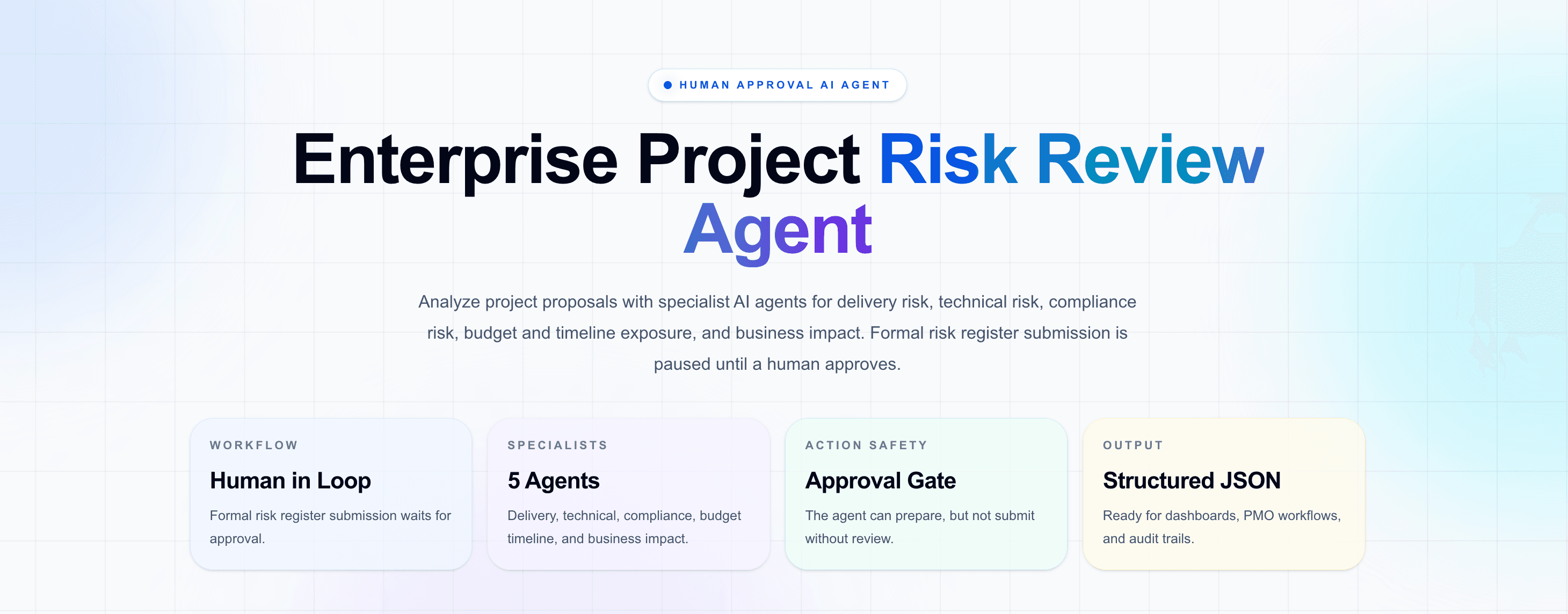
This AI Lab project demonstrates an enterprise project risk review agent with human review. The system analyzes a project proposal, evaluates delivery risk, reviews technical and architecture concerns, checks compliance and privacy exposure, assesses budget and timeline risk, evaluates business impact, and prepares structured project governance intelligence for human decision makers.
The goal is not to let AI automatically approve projects. The goal is to create a governed project risk intelligence layer where AI prepares the analysis, identifies missing information, highlights review requirements, prepares risk register entries, and keeps formal project risk actions under human control.
This project was created by Suhas Bhairav as part of an AI Lab series focused on practical, buildable, production-oriented AI systems.
What the Project Demonstrates
The project demonstrates how AI agents can support enterprise project governance workflows without bypassing human accountability. A project requester submits project details through a polished web interface. The backend analyzes the proposal using specialist agents and returns a structured risk review.
The workflow is designed around a common enterprise problem: project proposals often contain incomplete risk information, unclear dependencies, compressed timelines, budget uncertainty, privacy exposure, architecture concerns, and stakeholder pressure. Review boards, PMOs, architecture teams, privacy teams, security teams, and executives need a consistent way to evaluate risk before execution.
This AI agent helps organize that complexity. It does not replace project managers, architects, compliance reviewers, security teams, privacy officers, or executives. It gives them a faster, clearer, and more consistent project risk review package.
Core Capabilities
- Analyzes enterprise project proposals for risk and approval readiness.
- Reviews delivery risk, timeline pressure, resource constraints, scope clarity, and dependency risk.
- Evaluates technical risk including architecture, integration, security, scalability, reliability, and technical debt.
- Checks compliance and privacy exposure, including GDPR, DPIA requirements, data handling, data transfer, retention, and auditability.
- Assesses budget exposure, cost overrun risk, timeline slippage risk, and mitigation ideas.
- Evaluates business impact, strategic value, stakeholder impact, value drivers, urgency, and downside if delayed.
- Generates a risk register entry with primary risks, mitigation actions, owners, review cadence, and escalation requirements.
- Creates human review panels for approve or reject decisions.
- Produces structured JSON output for PMO dashboards, governance workflows, risk registers, and audit trails.
Why Human Approval Matters
Project risk review is a high-accountability workflow. A project decision can affect budget, timelines, data protection, security posture, customer experience, operational continuity, architecture stability, regulatory exposure, and executive commitments. For this reason, AI should not silently approve or submit formal project risk actions.
This project uses a human-in-the-loop pattern. The AI agent can analyze, summarize, recommend, and prepare the risk register entry. But a human reviewer must decide whether the recommendation should be accepted, rejected, paused, or sent back for more information.
In a production system, the same pattern can be extended to approval-protected tools where risk register submission, PMO workflow updates, Jira tickets, ServiceNow requests, architecture review board actions, or executive escalation workflows are paused until an authorized human approver confirms the action.
Example Project Risk Scenario
The demo scenario is a customer data platform migration. The project aims to migrate customer data from legacy CRM and support systems into a unified customer data platform. The business justification is strong because it can improve customer analytics, support personalization, reduce manual reporting, and create a single reliable customer view for product and support teams.
However, the project also has a high-risk profile. It involves personal data, sensitive data, external vendors, new technology, a hard go-live date, legal approvals, vendor onboarding, CRM API availability, data warehouse access, and legacy data quality issues. The budget is 180000 EUR, which triggers executive review based on the policy context.
Because of these issues, the system recommends requesting more information before proceeding. It flags missing privacy and compliance artifacts such as DPIA results, data flow diagrams, data processing agreements, vendor processing details, exact data categories, and processor information.
Project Risk Request Capture
The frontend captures project metadata such as project ID, project name, requester name, department, business unit, business owner, technical owner, region, project type, urgency, estimated budget, currency, duration, team size, and target go-live date.
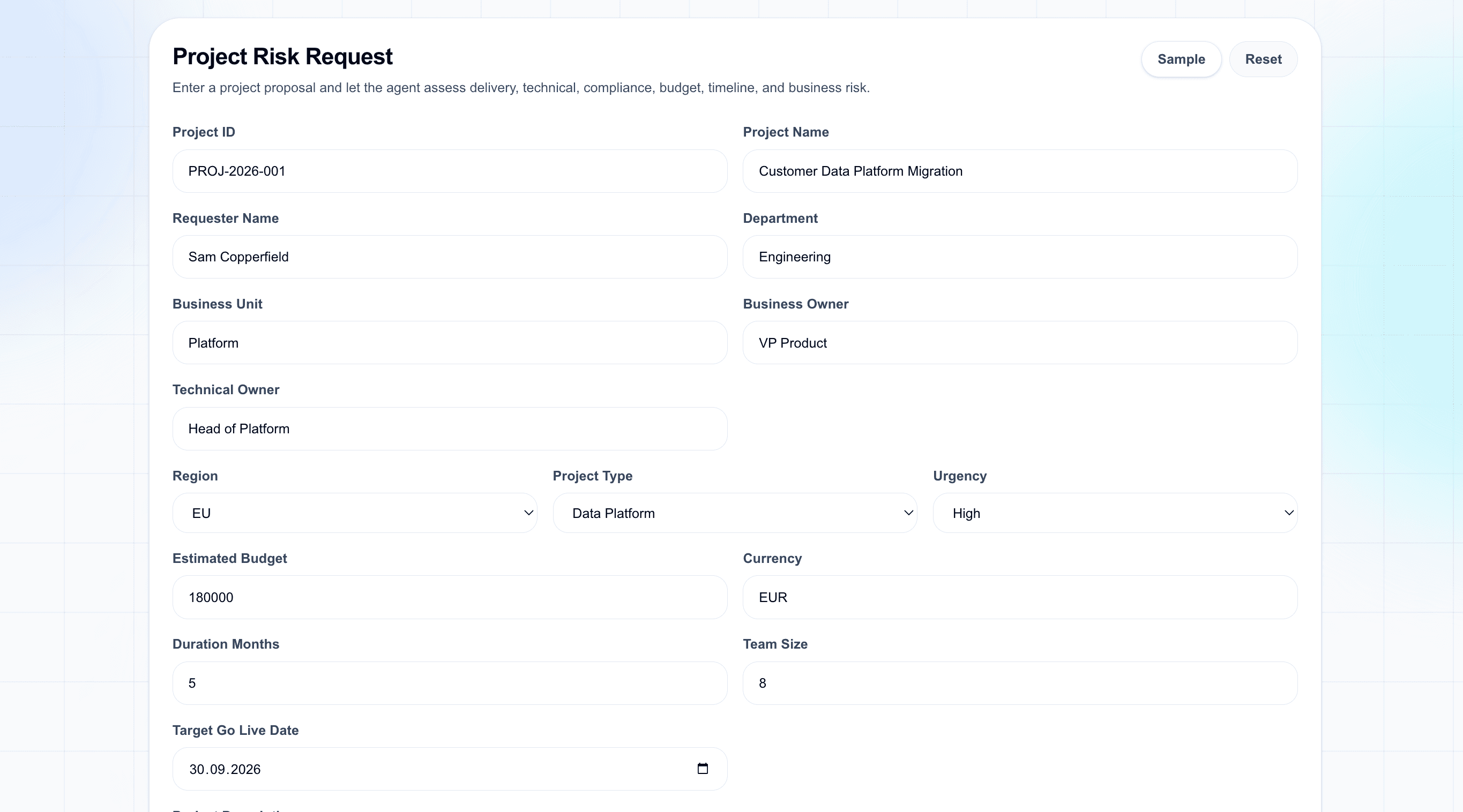
The form also captures business justification and core project risk indicators. These include whether the project contains personal data, contains sensitive data, uses external vendors, introduces new technology, or has a hard deadline.
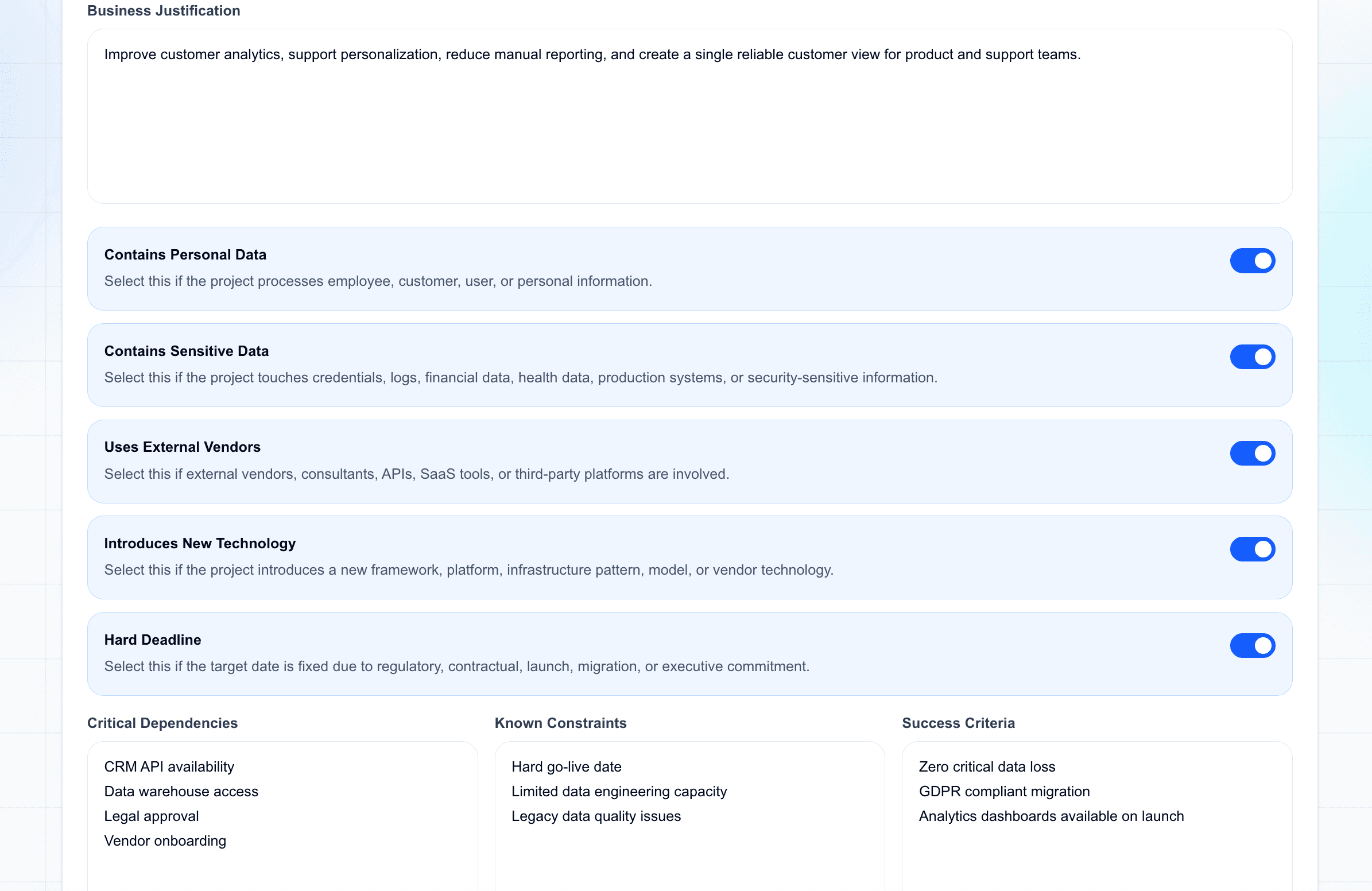
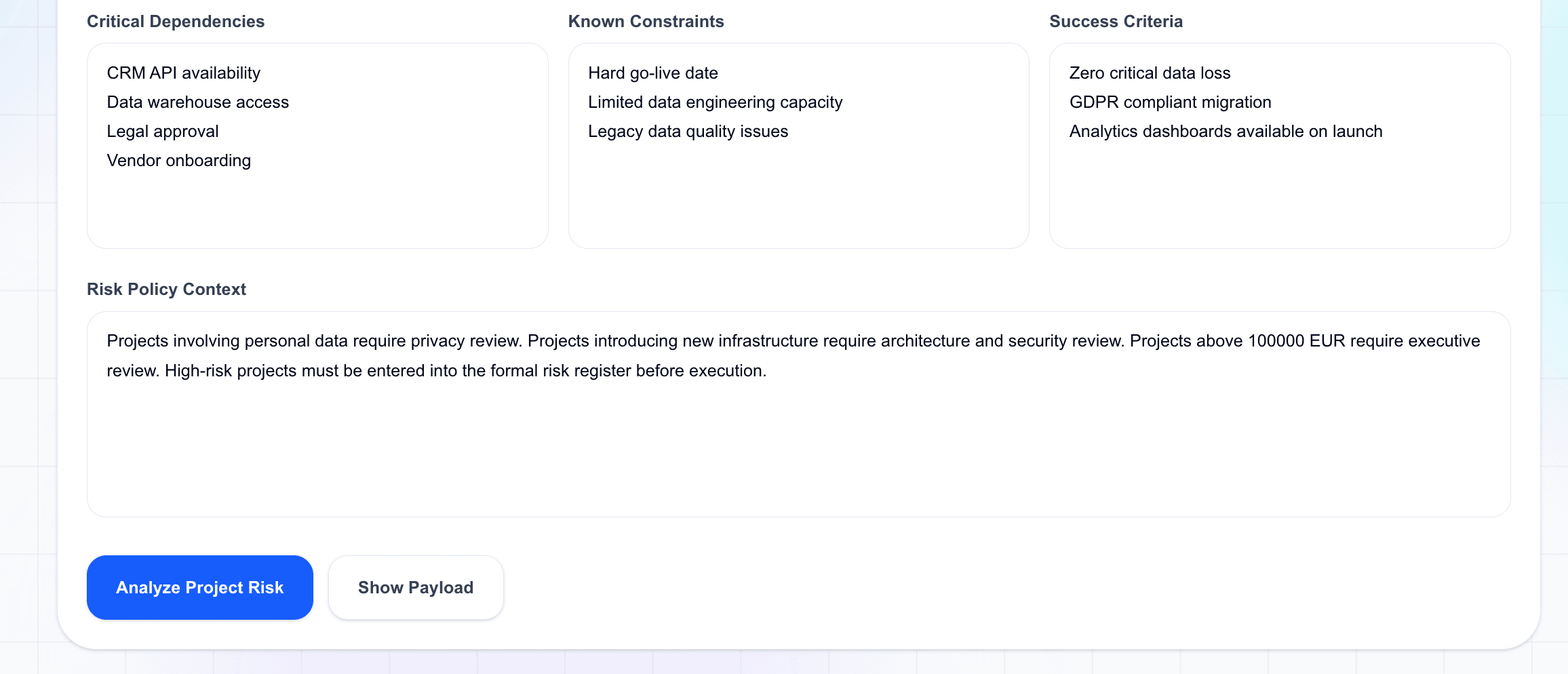
The lower part of the form captures critical dependencies, known constraints, success criteria, and risk policy context. This helps the agent evaluate project risk against the organization’s governance rules before producing a recommendation.
Specialist Agent Design
The system can be implemented with multiple specialist agents coordinated by an orchestrator. Each specialist focuses on one project risk responsibility. This mirrors how enterprise project reviews actually work, where PMO, architecture, security, privacy, finance, delivery, and business teams each review the same proposal from a different angle.
- The Delivery Risk Agent checks timeline concerns, dependencies, scope risk, resource constraints, and delivery confidence.
- The Technical Risk Agent evaluates architecture risk, integration risk, security concerns, scalability concerns, operational reliability, and technical debt.
- The Compliance Risk Agent checks privacy concerns, regulatory issues, data handling concerns, required reviews, and missing information.
- The Budget and Timeline Risk Agent evaluates budget exposure, cost concerns, schedule concerns, timeline slippage risk, and mitigation ideas.
- The Business Impact Agent evaluates strategic value, urgency, stakeholder impact, value drivers, downside if delayed, and whether the project should proceed.
- The Orchestrator combines the specialist results into one structured project risk analysis.
Human Review Decision
The project includes a dedicated human review decision panel. This is important because not every AI-assisted project workflow should immediately execute a backend tool. Sometimes the right behavior is to record a human decision after an advisory analysis.
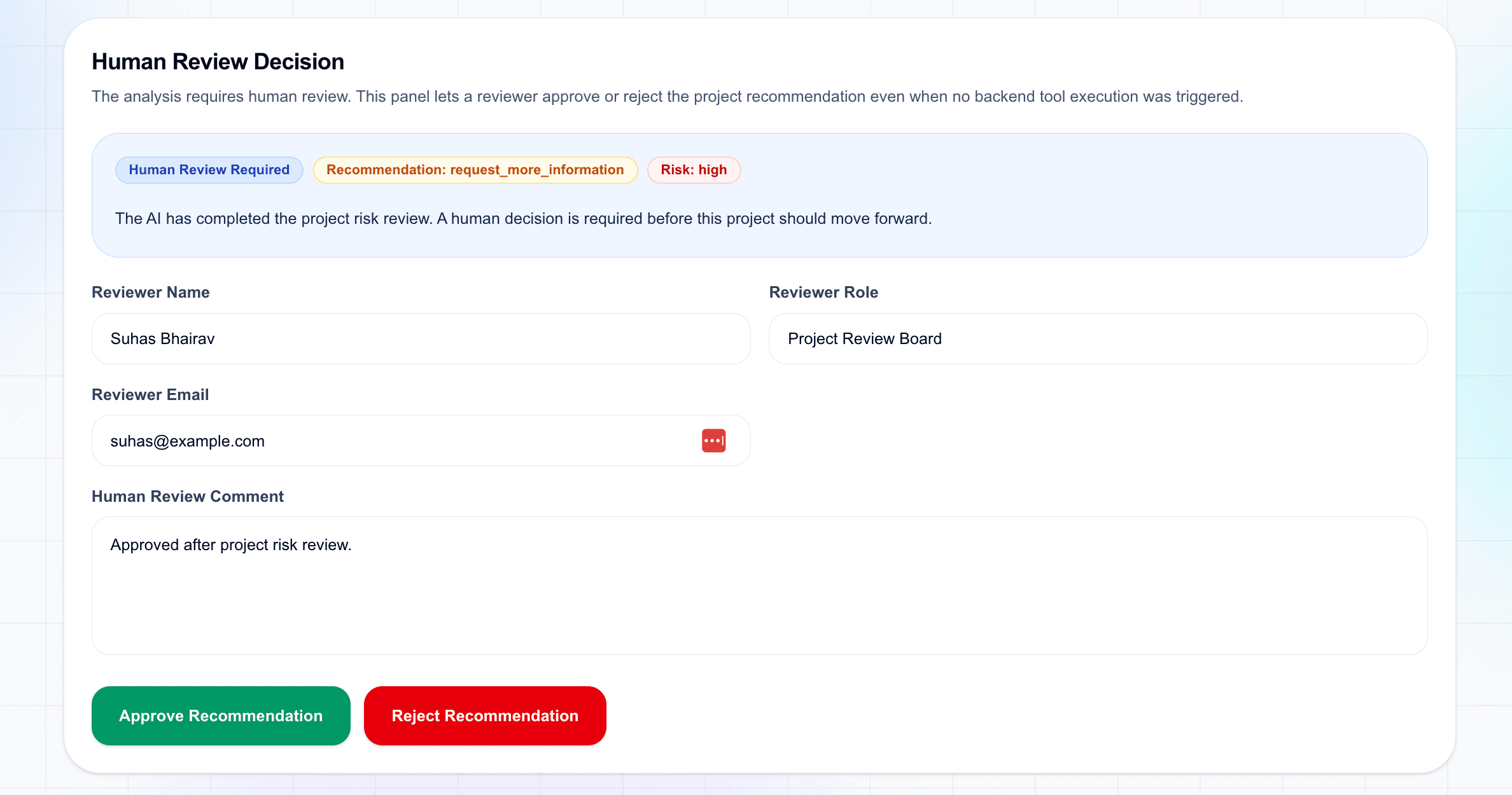
The panel captures reviewer name, reviewer role, reviewer email, and review comment. This creates a simple audit-friendly layer for demos and can be expanded into a persistent approval table in production.
Risk Summary and Executive Summary
The dashboard shows high-level project risk signals as summary cards: recommendation, overall risk, delivery risk, and budget exposure. These cards help reviewers understand the decision state quickly before reading the detailed sections.
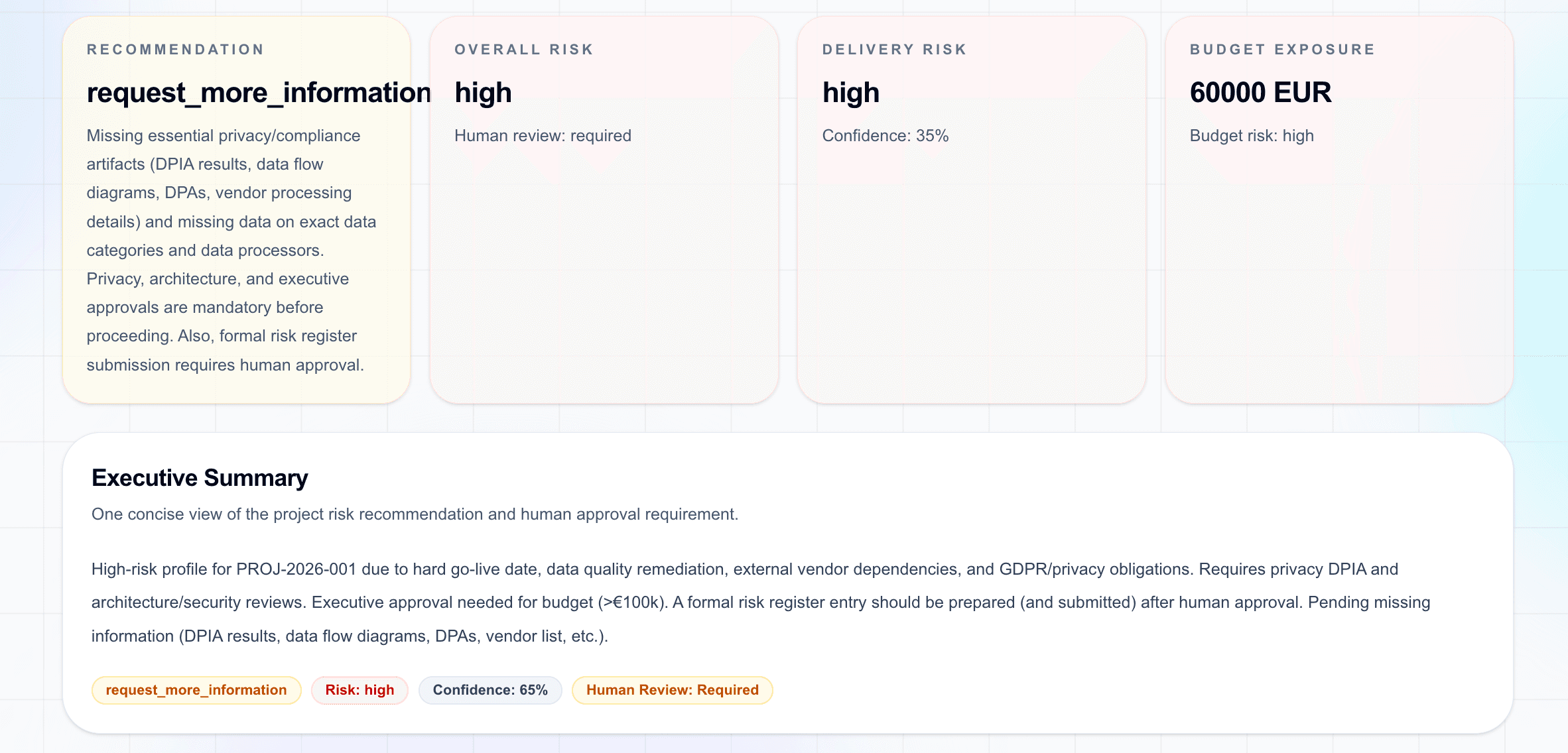
In the demo, the recommendation is request more information. The overall risk is high, delivery risk is high, and budget exposure is 60000 EUR. The executive summary explains that the project has a high-risk profile due to the hard go-live date, data quality remediation, external vendor dependencies, and GDPR/privacy obligations.
Delivery Risk and Technical Risk
The delivery risk section identifies timeline concerns, dependency risks, and scope risks. In the demo, the system flags a compressed timeline, limited data engineering capacity, reliance on CRM API availability, legal approval delays, vendor onboarding, testing windows, and unclear scope boundaries.
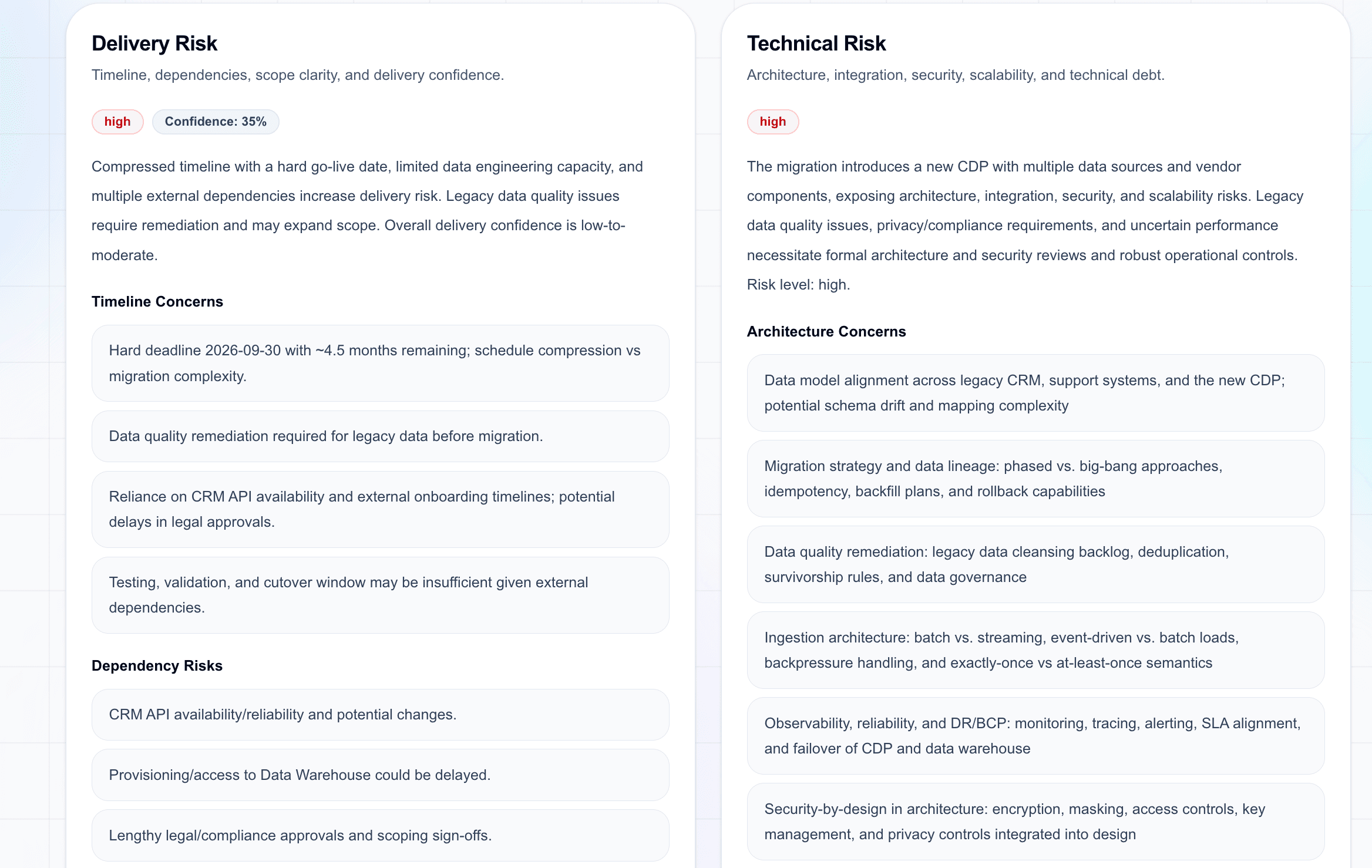
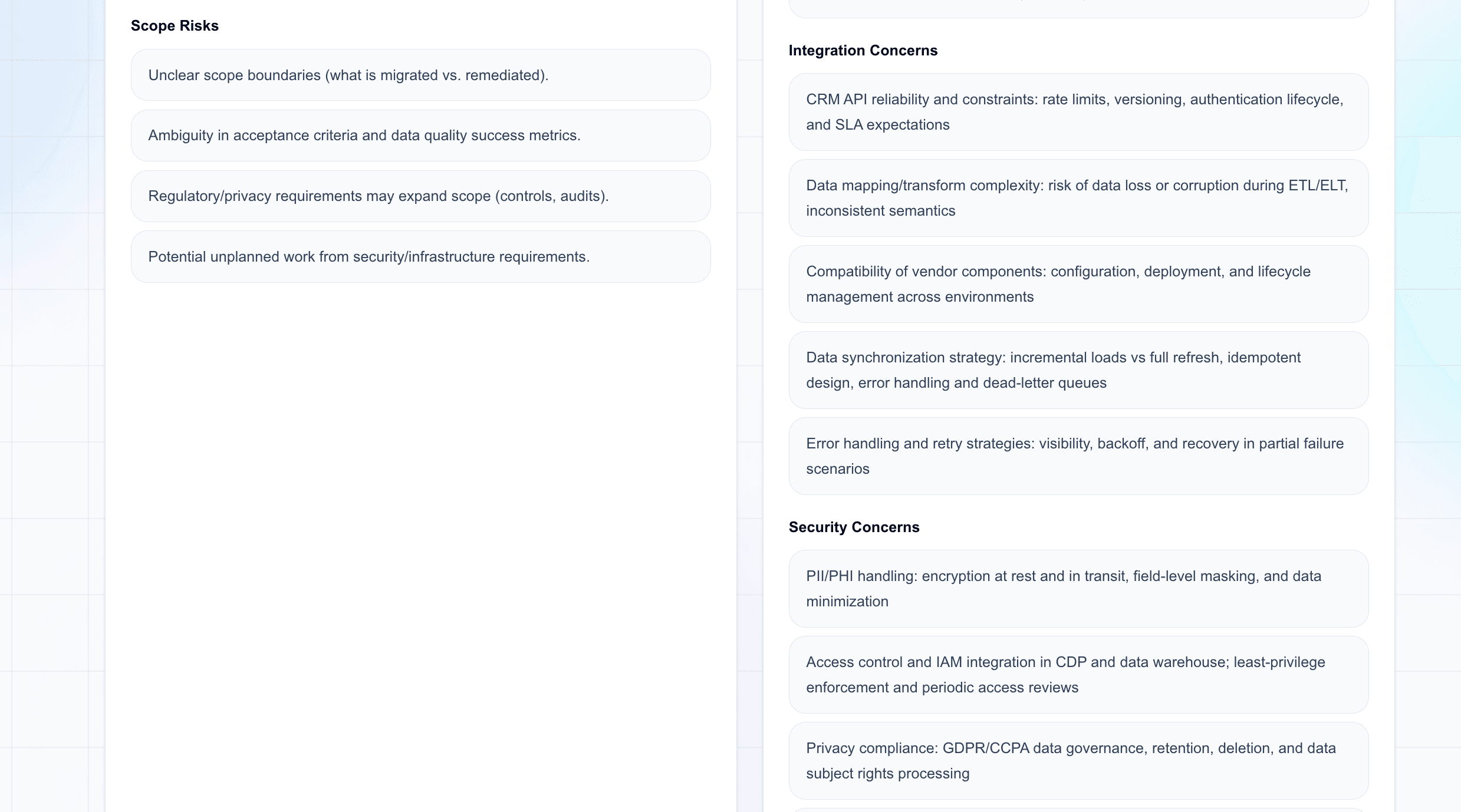
The technical risk section evaluates architecture concerns, integration concerns, security concerns, scalability, technical debt, operational controls, and reliability. For a customer data platform migration, the system highlights risks around data model alignment, migration strategy, data lineage, ingestion architecture, observability, access control, encryption, privacy controls, and rollback planning.
Compliance, Budget, and Timeline Risk
The compliance risk section evaluates privacy, regulatory, data handling, audit, and review requirements. In the demo, the project involves personal and sensitive data with GDPR obligations. The system recommends privacy impact assessment, vendor due diligence, data transfer mechanism assessment, data processing agreement review, retention policy alignment, and auditability controls.
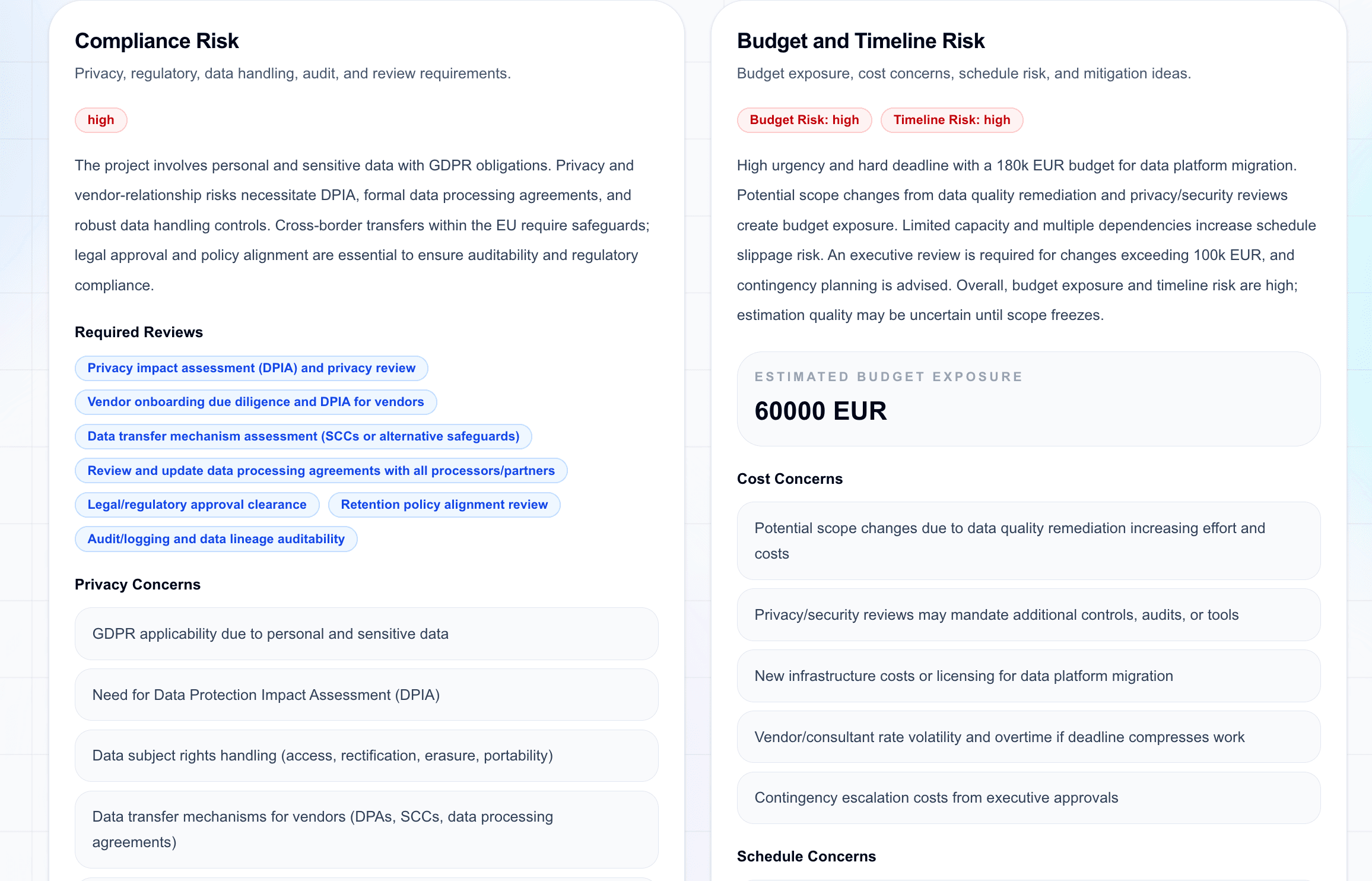
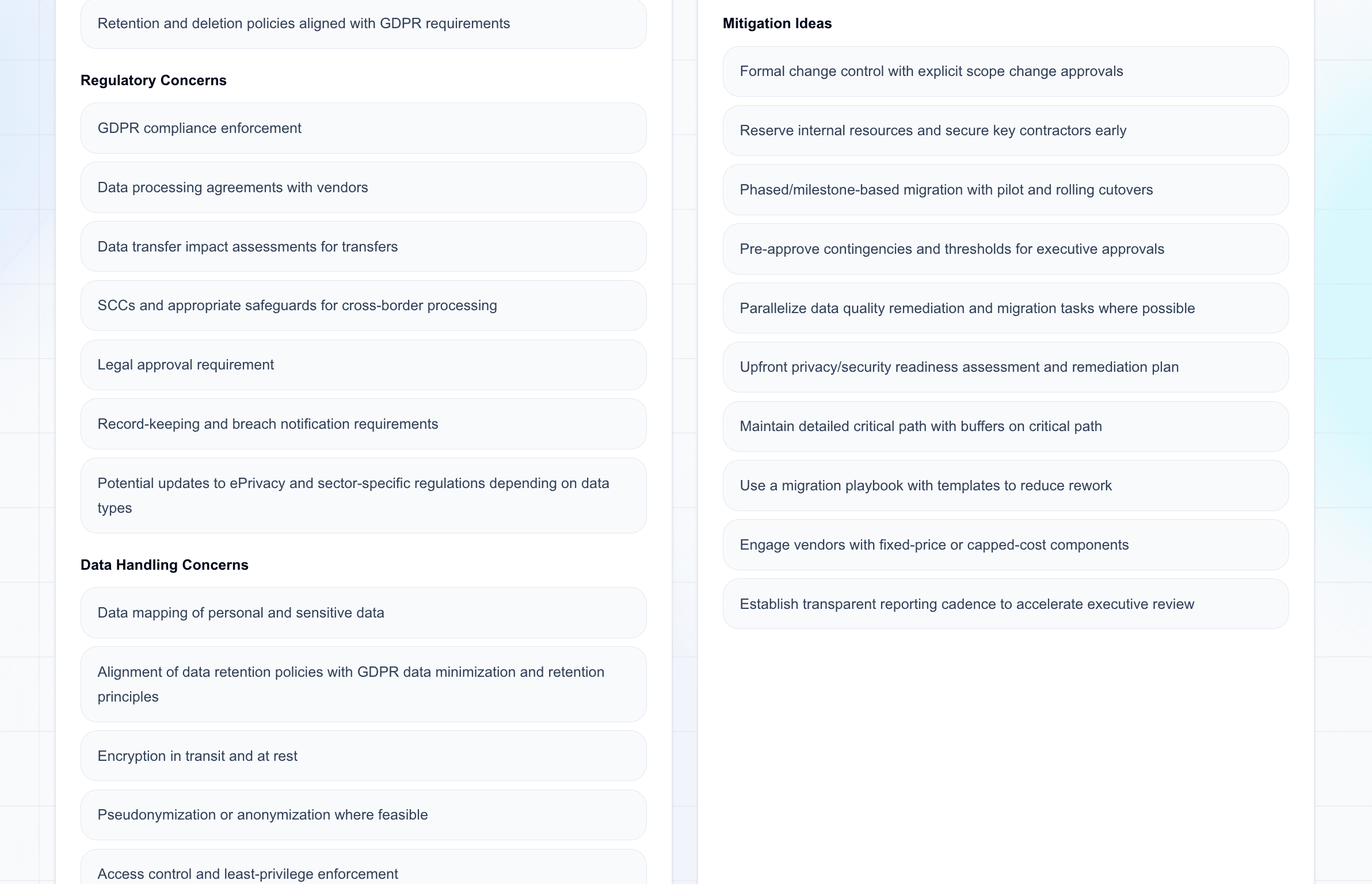
The budget and timeline risk section evaluates cost overrun exposure and schedule pressure. In the demo, the estimated budget exposure is 60000 EUR. The system explains that privacy and security reviews, data quality remediation, vendor dependencies, and hard deadline pressure can increase cost and timeline risk.
Business Impact
The business impact section evaluates whether the project still makes business sense. In the demo, the business impact is strategic and the urgency is high because a unified customer data platform can support analytics, personalization, a single customer view, GDPR-compliant migration, dashboards at launch, and improved reporting.
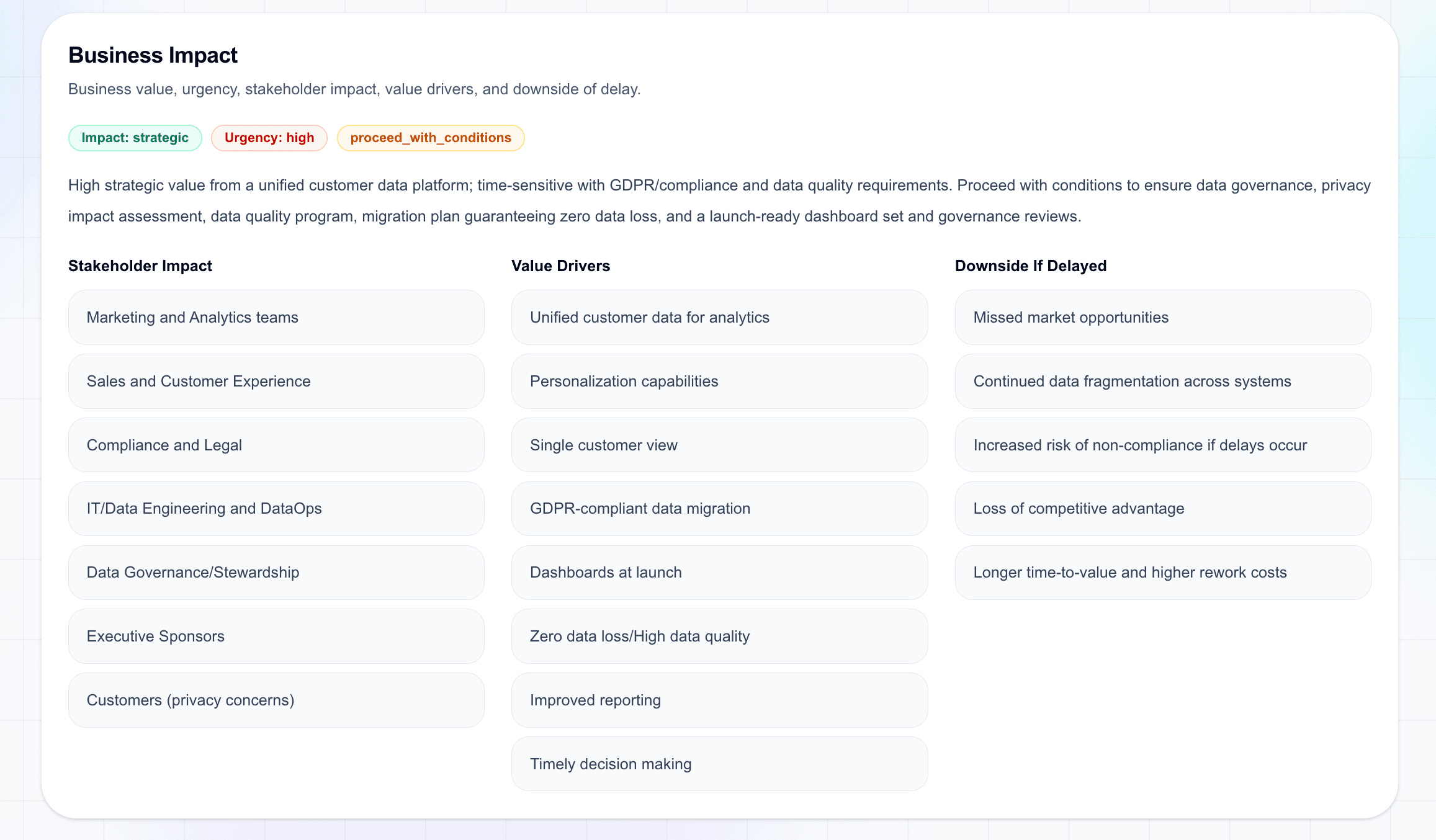
The recommendation at the business-impact level is proceed with conditions. This means the project has meaningful strategic value, but the governance package is not complete enough for unconditional approval. The system recommends conditions around data governance, privacy impact assessment, data quality planning, migration controls, zero data loss, and governance reviews.
Risk Register Entry
The agent prepares a risk register entry when project risk is medium, high, or critical. In the demo, the risk register entry has a high risk level, milestone-based review cadence, escalation requirement, primary risks, mitigation actions, and owners.
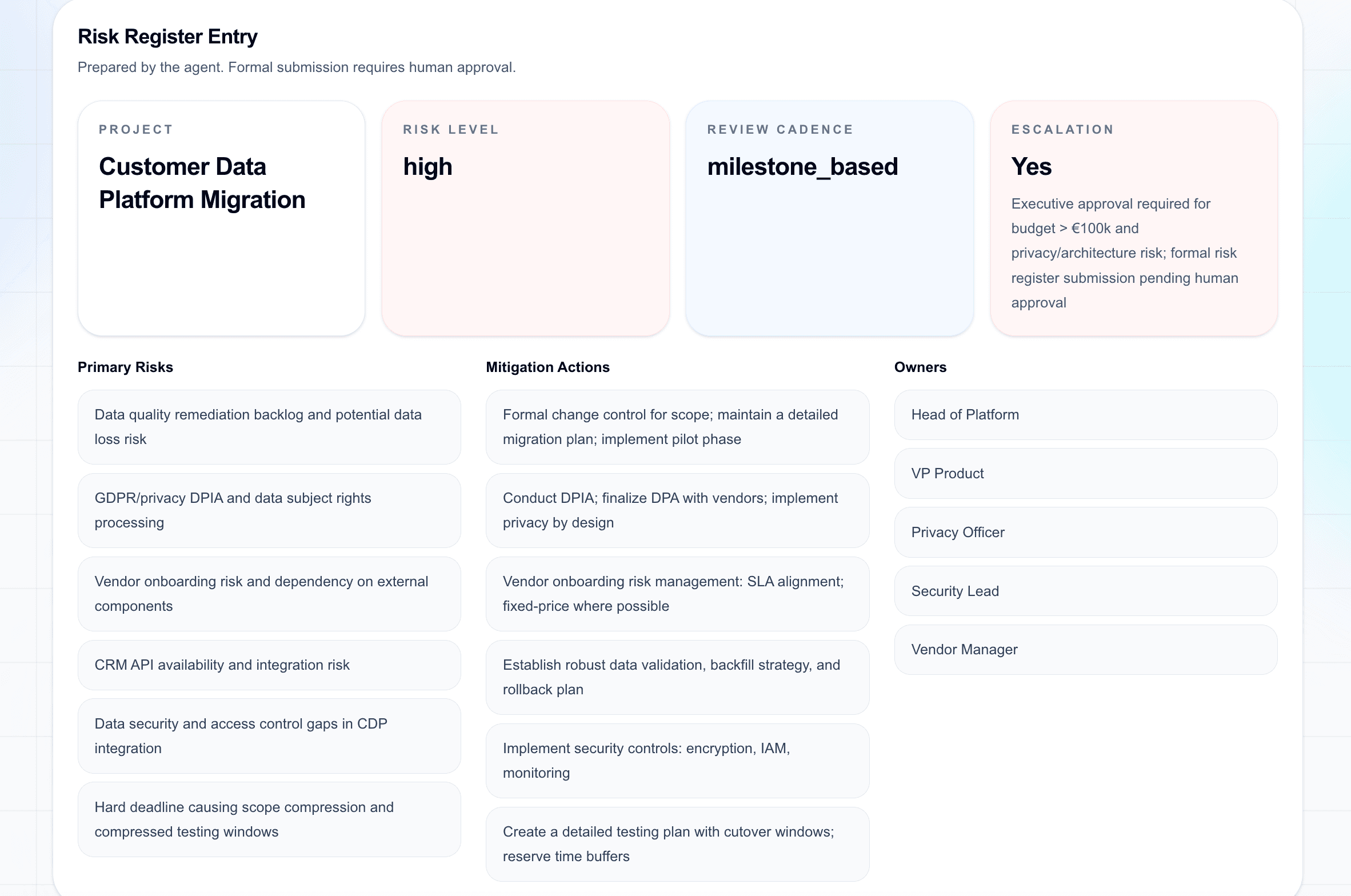
The primary risks include data quality remediation backlog, GDPR/privacy DPIA requirements, vendor onboarding risk, CRM API integration risk, access control gaps, and deadline pressure. The mitigation actions include formal change control, DPIA completion, vendor SLA alignment, validation and rollback planning, security controls, testing windows, and time buffers.
Governance Checks
The governance section shows whether human review is required, the overall risk level, whether PII or secrets were detected, the agent version, and the reasons for review. This turns the project review workflow into a traceable decision process rather than a one-off AI answer.
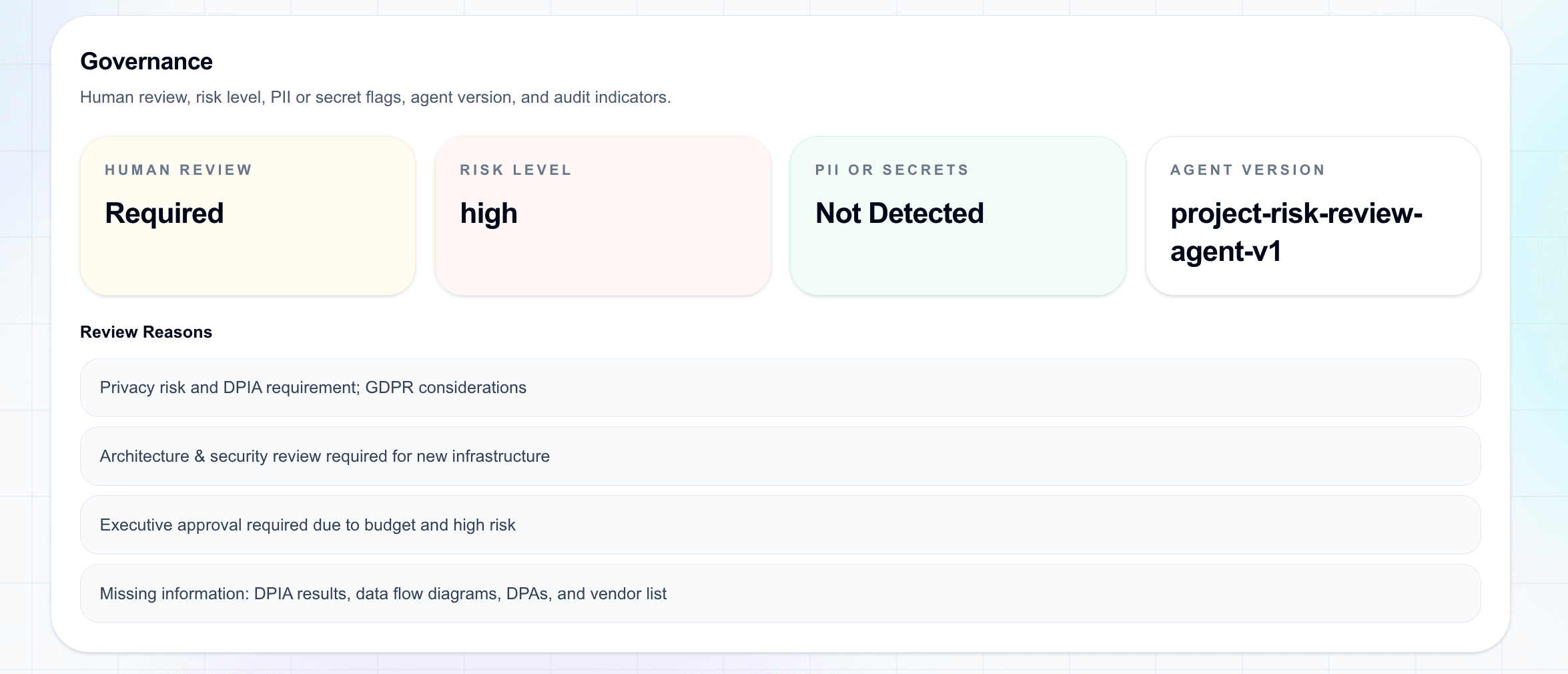
In the demo, human review is required because the project has privacy risk, DPIA requirements, GDPR considerations, architecture and security review requirements, executive approval needs, and missing information such as DPIA results, data flow diagrams, data processing agreements, and vendor list.
Implementation Pattern
The project is implemented as a Next.js App Router application with a client-side dashboard and a backend API route. The frontend manages form state, sample loading, payload preview, analysis results, human review decisions, and structured UI rendering. The backend can use the OpenAI Agents SDK, Zod schemas, input guardrails, output guardrails, specialist agents, and approval-protected tools.
The system can run locally with in-memory approval state for demos. For production deployment, approval state should be stored in a durable database or Redis-like store, and sensitive risk actions should be connected only after authentication, authorization, role checks, and audit logging are implemented.
Where This Fits in Enterprise AI
This project sits at the intersection of AI agents, project governance, PMO workflows, architecture review, compliance review, privacy review, security review, budget control, timeline risk management, executive approval, and risk register automation.
The strongest use case is not automatic project approval. The strongest use case is project risk intelligence: faster review, clearer missing information, consistent risk assessment, better approval routing, stronger mitigation planning, and safer human decision making.
Potential Extensions
- Connect to project management tools such as Jira, Azure DevOps, Asana, Monday.com, or Linear.
- Connect to PMO and governance tools such as ServiceNow, Clarity, Planview, or custom portfolio management systems.
- Add role-based access control for project owners, PMO reviewers, architects, security teams, privacy teams, finance teams, and executives.
- Store reviewer decisions, timestamps, comments, risk scores, risk register entries, and state transitions in a database.
- Add retrieval over project governance policies, architecture standards, security policies, privacy policies, risk frameworks, and PMO playbooks.
- Add approval chains based on budget, risk level, region, data sensitivity, project type, and executive impact.
- Add automatic risk register updates after human approval.
- Add Jira or ServiceNow ticket creation for mitigation actions.
- Add Slack, Teams, or email notifications for reviewers.
- Add dashboards for project portfolio risk, repeated risk patterns, budget exposure, and review bottlenecks.
Strategic Value
Enterprise project reviews are often slow because project details, technical concerns, compliance obligations, budget assumptions, timelines, and stakeholder inputs are scattered across documents and meetings. An AI project risk review agent can reduce review friction by turning an incomplete or messy project proposal into a structured decision package.
The business value is not only faster project review. The deeper value is better governance: every project becomes easier to evaluate, explain, route, mitigate, approve, and audit.
Conclusion
The Enterprise Project Risk Review Agent demonstrates how AI agents can be applied to a high-accountability enterprise workflow. It combines specialist analysis, human review, structured output, risk scoring, risk register preparation, approval guidance, mitigation planning, and governance checks in a practical implementation.
This AI Lab project is intentionally implementation-focused. It shows how a real project risk review workflow can be transformed from a manual review process into a structured AI-assisted governance system while keeping humans in control.
FAQ
What is an enterprise project risk review agent?
It is an AI-assisted workflow that analyzes project proposals, reviews delivery risk, evaluates technical and compliance concerns, assesses budget and timeline exposure, prepares risk register entries, and supports human project governance decisions.
Does the AI automatically approve projects?
No. The system is designed for human-in-the-loop project governance. The AI can recommend, summarize, and prepare the risk package, but a human reviewer remains responsible for approving, rejecting, pausing, or requesting more information.
Why is human approval important in project risk AI?
Project decisions can affect budget, delivery commitments, security posture, privacy obligations, architecture stability, operational continuity, and executive accountability. Human approval prevents sensitive project risk actions from being executed without review.
What does the system analyze?
It analyzes delivery risk, timeline concerns, dependency risks, scope risks, technical architecture concerns, integration risks, security concerns, compliance risk, privacy obligations, budget exposure, mitigation ideas, business impact, risk register entries, and governance review reasons.
What technologies are used in this project?
The project uses Next.js, React, Tailwind CSS, JavaScript, the OpenAI Agents SDK, Zod schemas, structured JSON output, and human-in-the-loop approval logic.
Can this connect to real PMO or project management systems?
Yes. The workflow can be extended to integrate with Jira, Azure DevOps, ServiceNow, Planview, Clarity, Asana, Monday.com, Slack, Microsoft Teams, email, and internal project approval workflows.
What is the main business value?
The main value is faster project risk review, clearer approval requirements, better visibility into delivery and technical risks, stronger compliance routing, better mitigation planning, and safer human-controlled project governance decisions.
About the Builder
Suhas Bhairav builds production-grade AI applications, multi-agent systems, RAG systems, knowledge graph workflows, and enterprise AI prototypes. Learn more at https://suhasbhairav.com.