This AI Lab project demonstrates an enterprise contract renewal agent with human review. The system analyzes a renewal request, evaluates renewal policy compliance, reviews vendor performance, assesses commercial impact, checks legal risk, evaluates the business case, and produces structured contract governance intelligence for human decision makers.
The goal is not to let AI automatically renew contracts. The goal is to create a governed contract renewal intelligence layer where AI prepares the analysis, identifies risks, highlights missing approvals, recommends negotiation points, and keeps sensitive renewal execution under human control.
This project was created by Suhas Bhairav as part of an AI Lab series focused on practical, buildable, production-oriented AI systems.
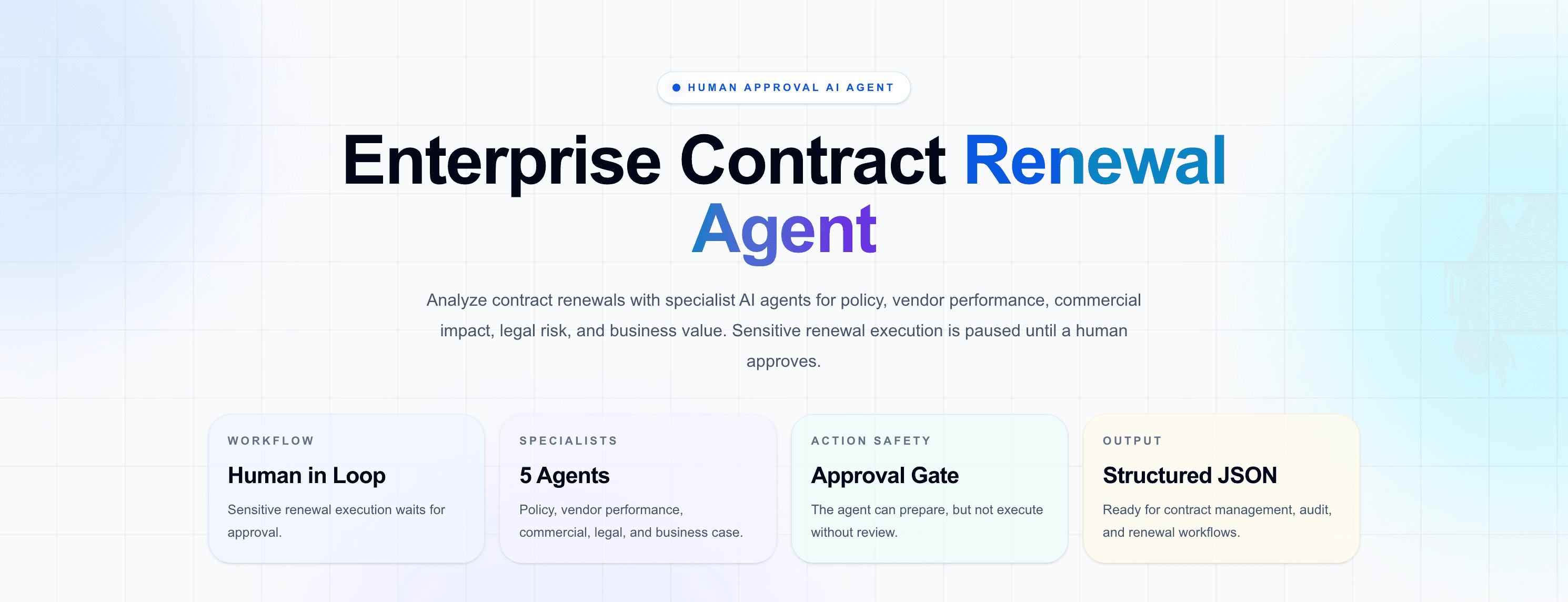
What the Project Demonstrates
The project demonstrates how AI agents can support enterprise contract renewal workflows without bypassing governance. A contract owner submits renewal details through a polished web interface. The backend analyzes the renewal using specialist agents and returns a structured renewal assessment.
The workflow is designed around a real enterprise problem: contract renewals are often time-sensitive, policy-heavy, and dependent on multiple review teams. A renewal may require finance approval, legal review, security review, privacy review, commercial renegotiation, vendor performance validation, and executive approval before execution.
This AI agent helps organize that complexity. It does not replace contract managers, procurement teams, finance teams, or legal reviewers. It gives them a faster, clearer, and more consistent renewal review package.
Core Capabilities
- Analyzes contract renewal requests for approval readiness.
- Reviews renewal policy compliance and required approval paths.
- Identifies missing information before renewal execution.
- Assesses vendor performance, SLA gaps, incidents, complaints, and support quality.
- Evaluates commercial impact, current annual cost, proposed annual cost, price increase, and cost concerns.
- Identifies negotiation levers such as discounts, fixed pricing, SLA credits, improved escalation paths, and renewal conditions.
- Reviews legal risk, contract clauses, data processing terms, security addendums, termination rights, and audit rights.
- Evaluates business value, operational dependency, switching cost, migration risk, and renewal rationale.
- Generates human review panels for approve or reject decisions.
- Produces structured JSON output for contract management, procurement, audit, and workflow tools.
Why Human Approval Matters
Contract renewal is a high-accountability workflow. A renewal can affect budget, vendor lock-in, pricing commitments, service reliability, security posture, privacy obligations, legal exposure, operational continuity, and negotiation leverage. For this reason, AI should not silently execute contract renewals.
This project uses a human-in-the-loop pattern. The AI agent can analyze, recommend, summarize, and prepare the renewal for review. But a human reviewer must decide whether the recommendation should be accepted, rejected, renegotiated, or sent back for more information.
In a production system, the same pattern can be extended to approval-protected tools where renewal execution, contract management updates, vendor communications, finance approvals, or legal workflows are paused until an authorized human approver confirms the action.
Example Contract Renewal Scenario
The demo scenario is a cloud observability platform renewal for an engineering and SRE team. The platform is mission-critical because it supports production monitoring, incident response, reliability reporting, latency tracking, and API health visibility.
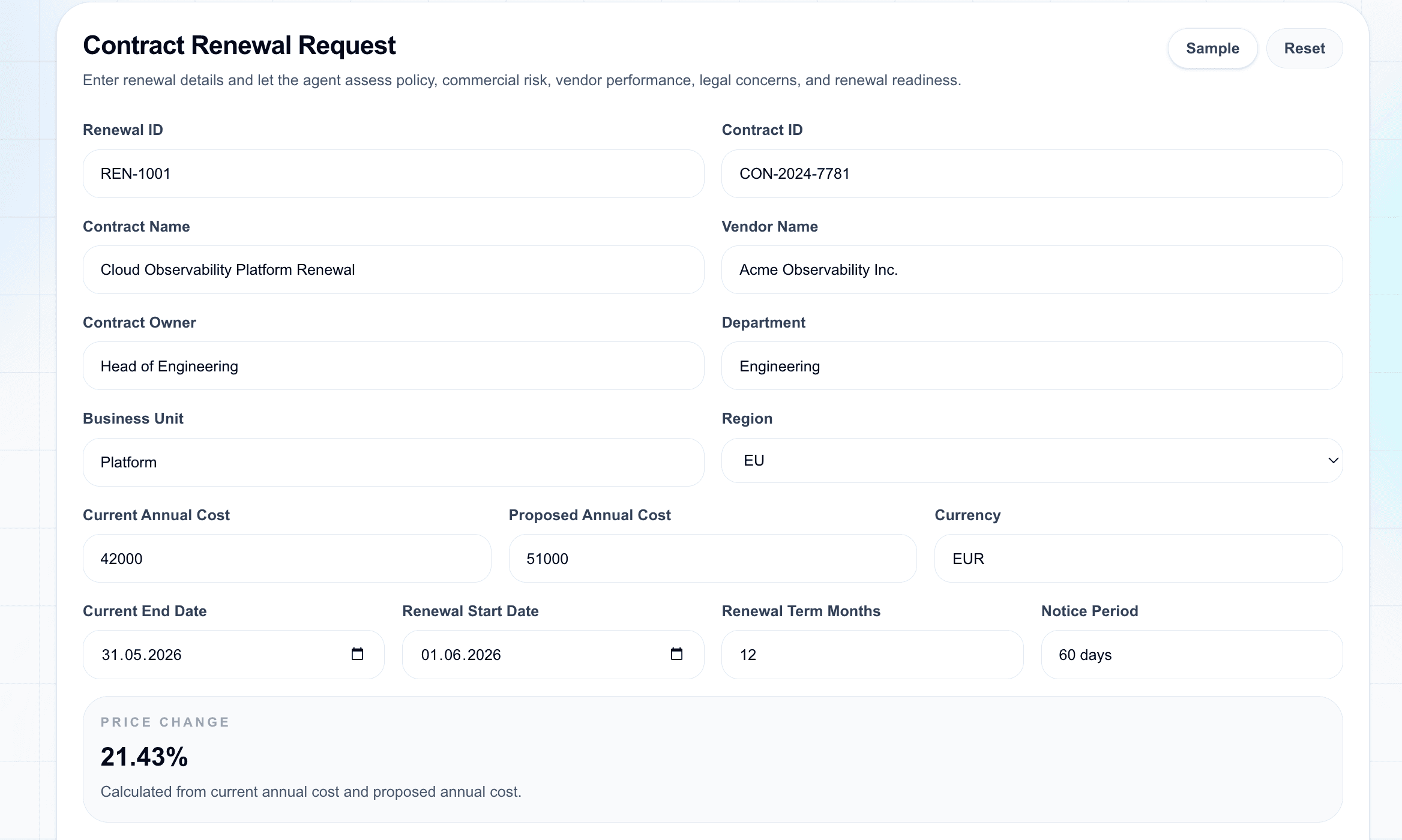
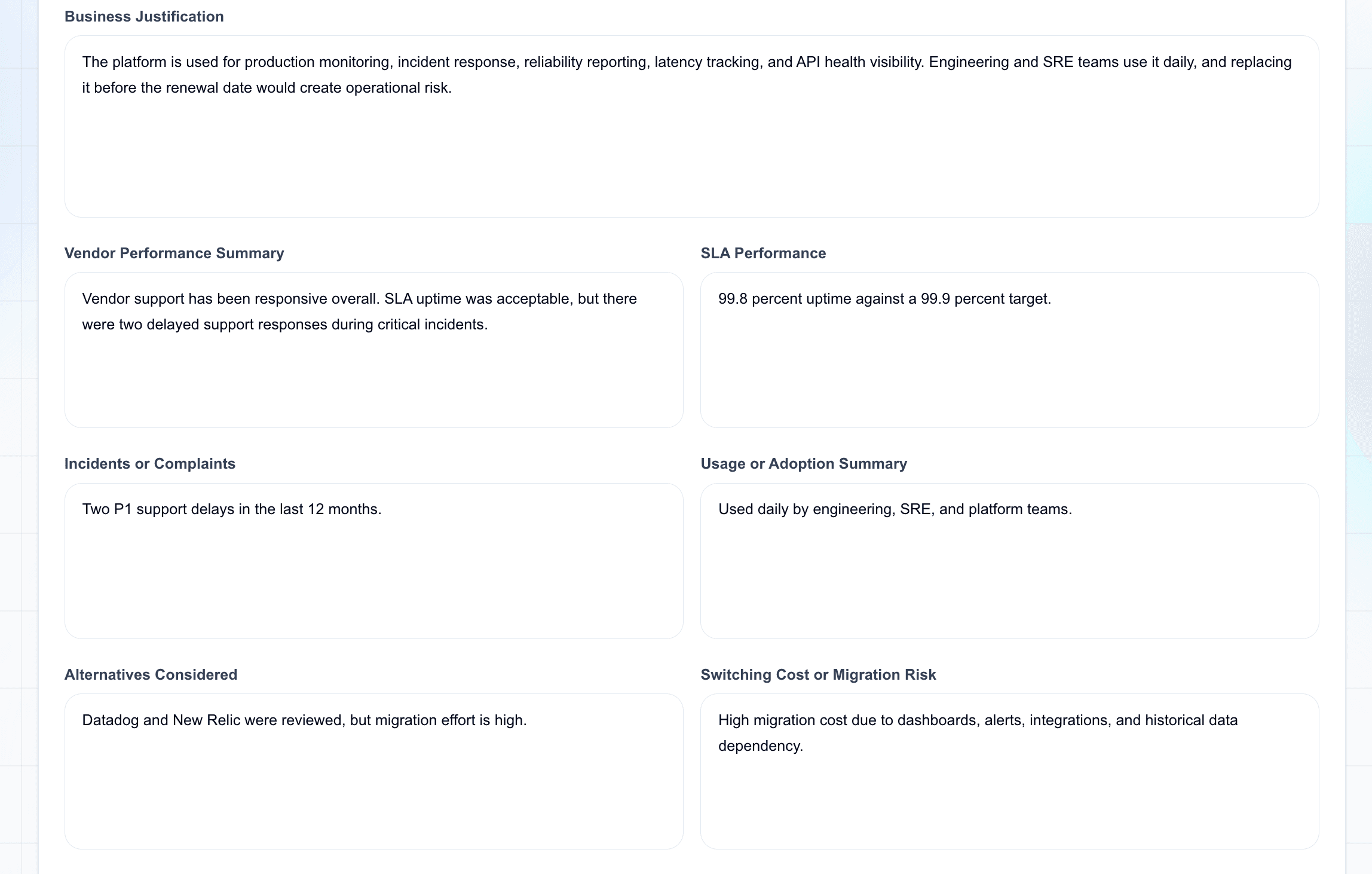
However, the renewal also introduces governance concerns. The proposed annual cost increases from 42000 EUR to 51000 EUR, a 21.43 percent increase. The contract involves personal data and security-sensitive operational data. The vendor is critical, but there were two P1 support delays and SLA performance was 99.8 percent against a 99.9 percent target.
Because of these issues, the system recommends renegotiation rather than a straight renewal. It flags finance, security, privacy, and legal approval requirements before execution.
Contract Renewal Request Capture
The frontend captures renewal metadata such as renewal ID, contract ID, contract name, vendor name, contract owner, department, business unit, region, current annual cost, proposed annual cost, currency, contract end date, renewal start date, renewal term, and notice period.
The form also captures business and vendor context: business justification, vendor performance summary, SLA performance, incidents or complaints, usage summary, alternatives considered, and switching cost or migration risk.
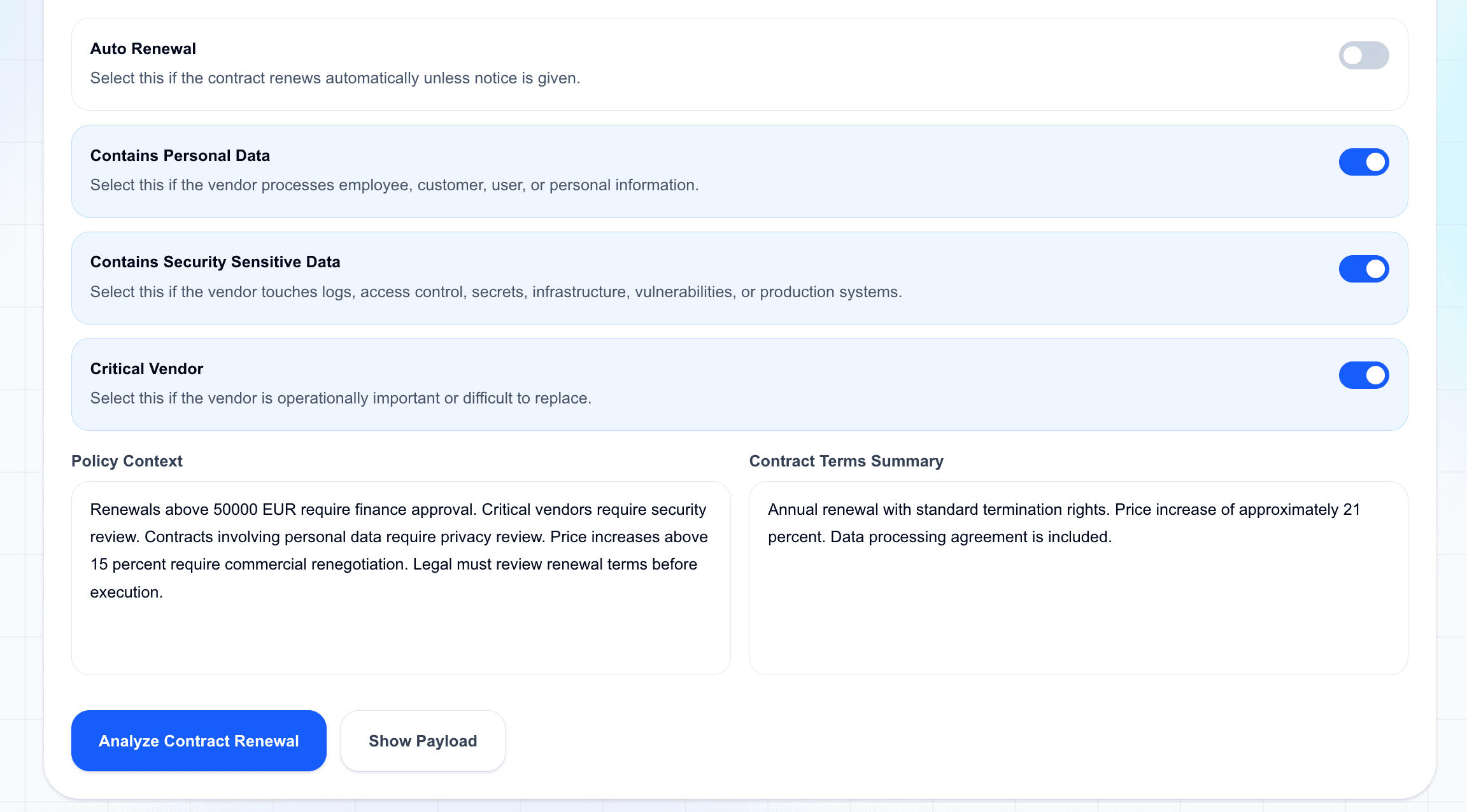
The lower part of the form captures governance and contract risk context: whether the contract auto-renews, whether the vendor processes personal data, whether the vendor touches security-sensitive data, whether the vendor is critical, what policy rules apply, and what contract terms need review.
Specialist Agent Design
The system can be implemented with multiple specialist agents coordinated by an orchestrator. Each specialist focuses on one contract renewal responsibility. This mirrors how enterprise renewals actually work, where finance, procurement, legal, security, privacy, IT, and business owners each review the same renewal from a different angle.
- The Renewal Policy Agent checks approval path, policy status, renewal constraints, missing information, and blocking conditions.
- The Vendor Performance Agent evaluates SLA performance, support quality, incidents, complaints, operational dependency, and vendor action recommendations.
- The Commercial Impact Agent evaluates current annual cost, proposed annual cost, price increase, commercial risk, cost concerns, and negotiation levers.
- The Legal Risk Agent reviews contract concerns, renewal clauses, data processing terms, security clauses, termination rights, audit rights, and legal action requirements.
- The Renewal Business Case Agent evaluates business value, operational dependency, switching cost, migration risk, renewal recommendation, and rationale.
- The Orchestrator combines the specialist results into one structured renewal analysis.
Human Review Decision
The project includes a dedicated human review decision panel. This is important because not every AI-assisted renewal workflow should immediately execute a backend tool. Sometimes the right behavior is to record a human decision after an advisory analysis.
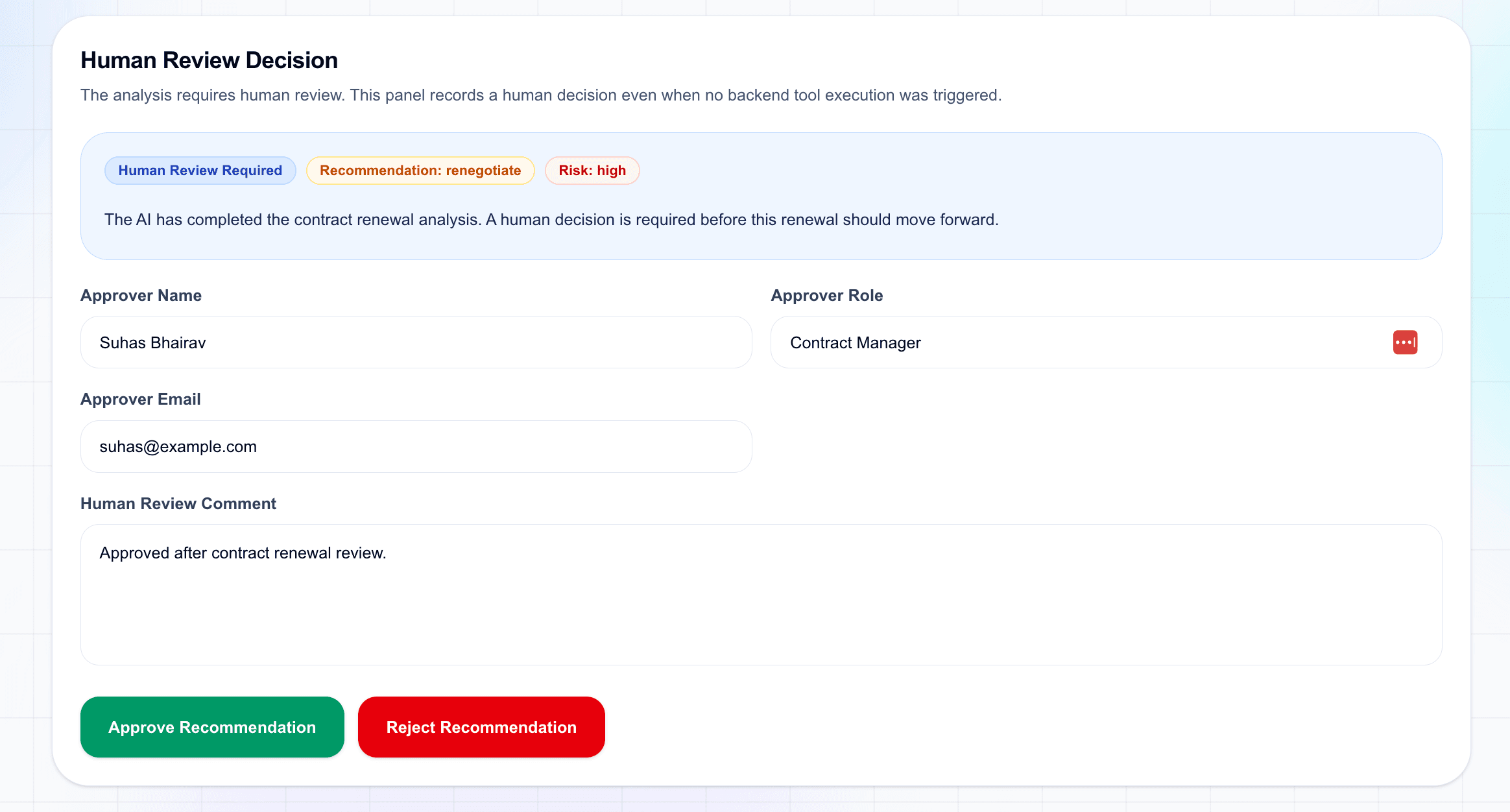
The panel captures approver name, approver role, approver email, and review comment. This creates a simple audit-friendly layer for demos and can be expanded into a persistent approval table in production.
Risk Summary and Executive Summary
The dashboard shows high-level renewal signals as summary cards: recommendation, policy status, vendor performance, and proposed annual cost. These cards help reviewers understand the decision state quickly before reading the detailed sections.
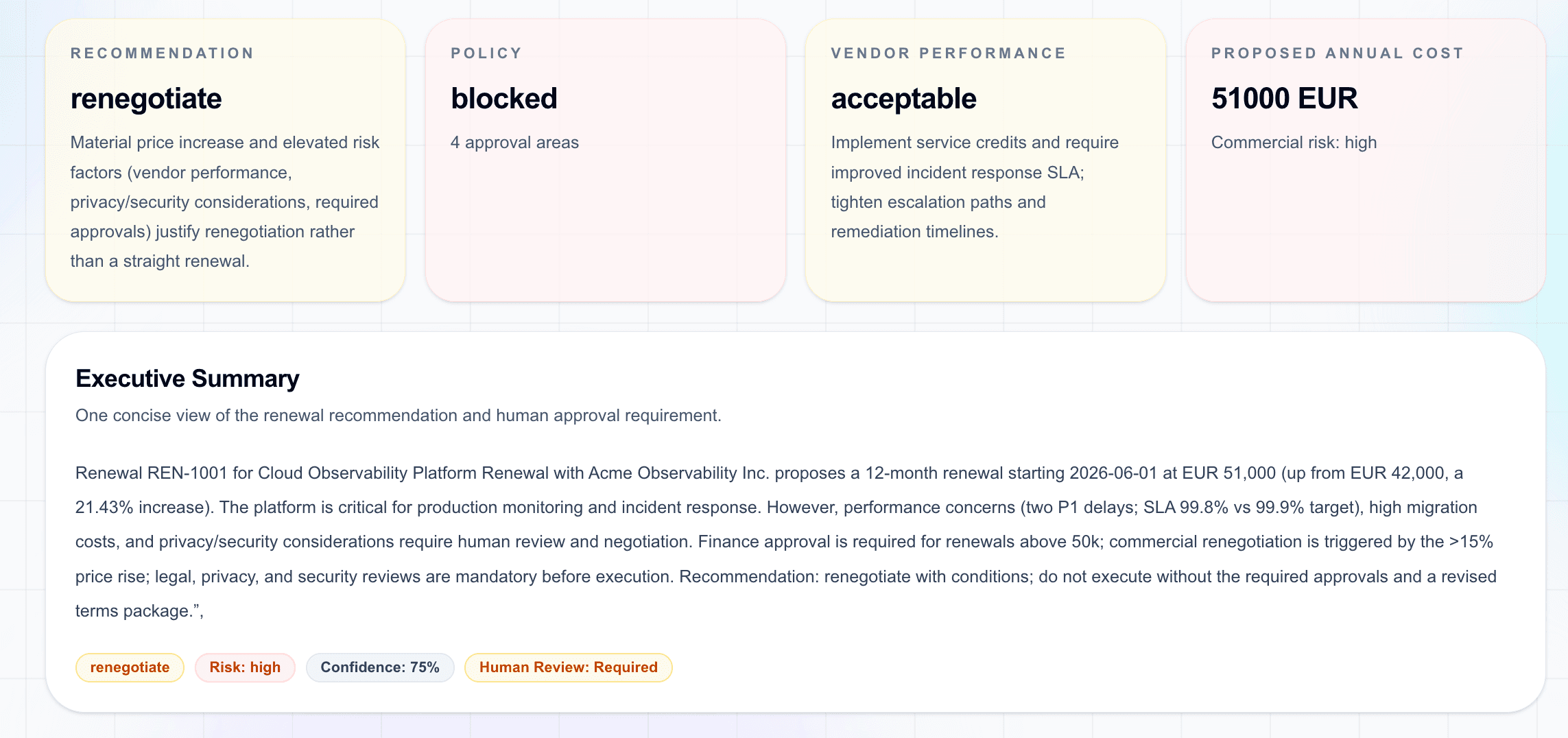
In the demo, the recommendation is renegotiate. The policy status is blocked because required approvals are missing. Vendor performance is acceptable but not strong enough for a straight renewal. The proposed annual cost is 51000 EUR and the overall risk level is high.
Policy Review and Vendor Performance
The policy review section identifies required approvals such as finance, security, privacy, and legal review. It also lists renewal constraints, policy concerns, and missing information that must be resolved before renewal execution.
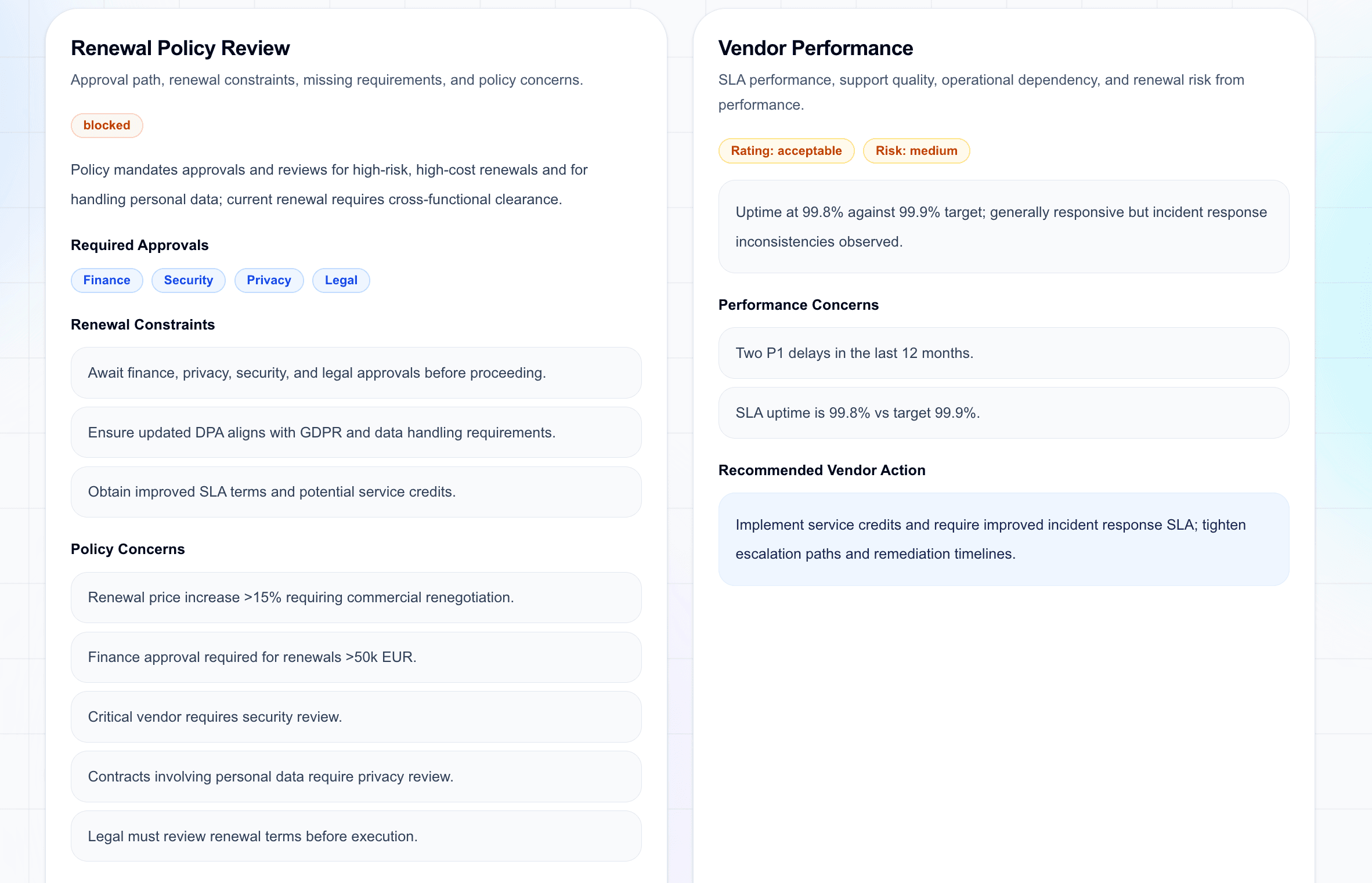
The vendor performance section evaluates service quality, SLA performance, support responsiveness, operational dependency, and vendor action recommendations. In the demo, the system recommends improved incident response SLA, tighter escalation paths, remediation timelines, and possible service credits.
Commercial Impact and Legal Risk
The commercial impact section evaluates the cost change from current annual cost to proposed annual cost. In the demo, the renewal price increase is 21.43 percent, which triggers commercial risk and negotiation requirements.
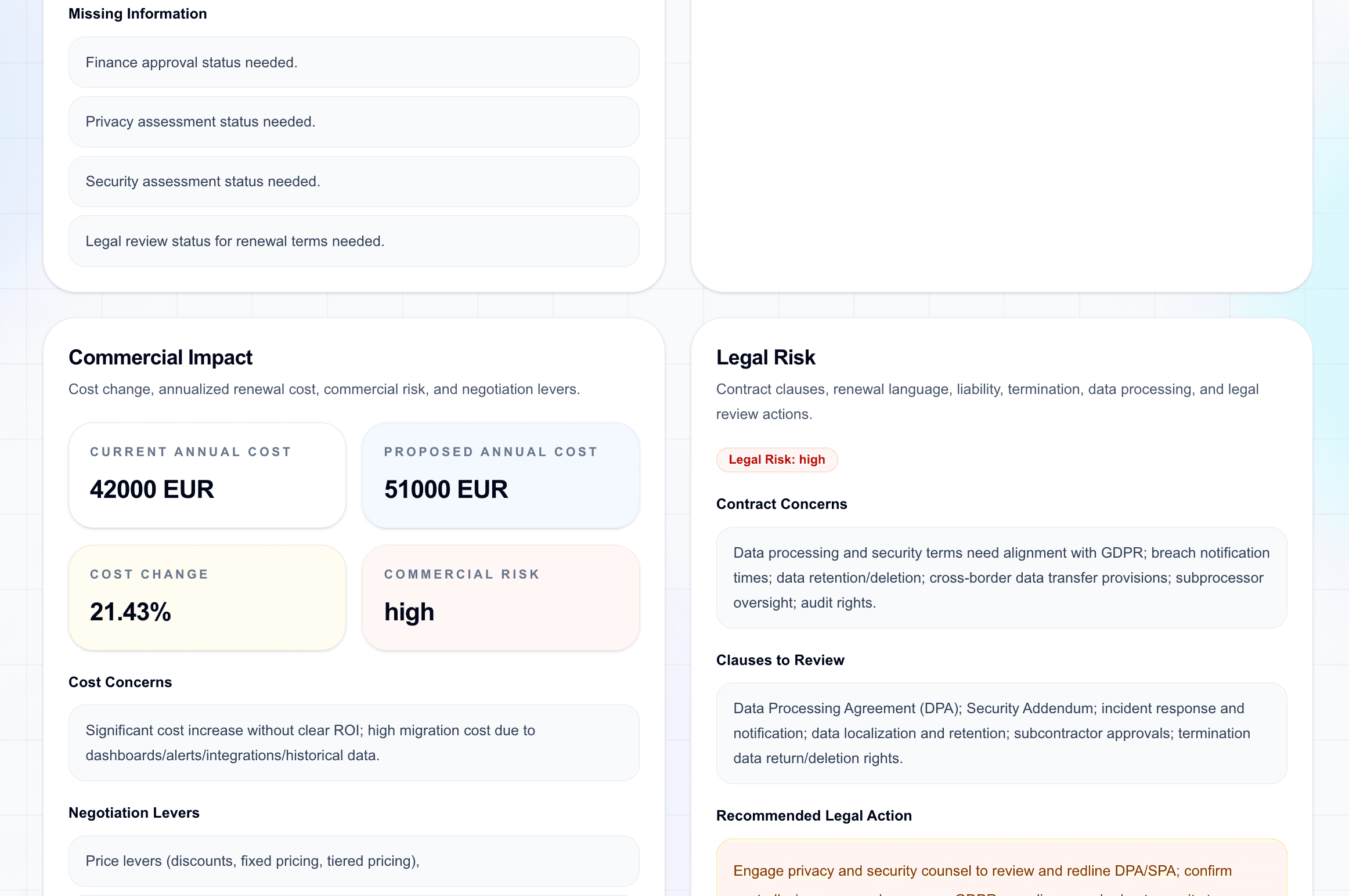
The legal risk section reviews contract concerns and clauses to review, including the data processing agreement, security addendum, incident response terms, data localization and retention, subcontractor approvals, termination rights, audit rights, and data return or deletion rights.
Business Case and Governance Checks
The business case section evaluates whether the renewal still makes business sense. In the demo, the business value is high because the platform is mission-critical and deeply used by engineering and SRE teams. However, the recommendation remains renegotiate because of pricing, SLA, privacy, security, and legal concerns.
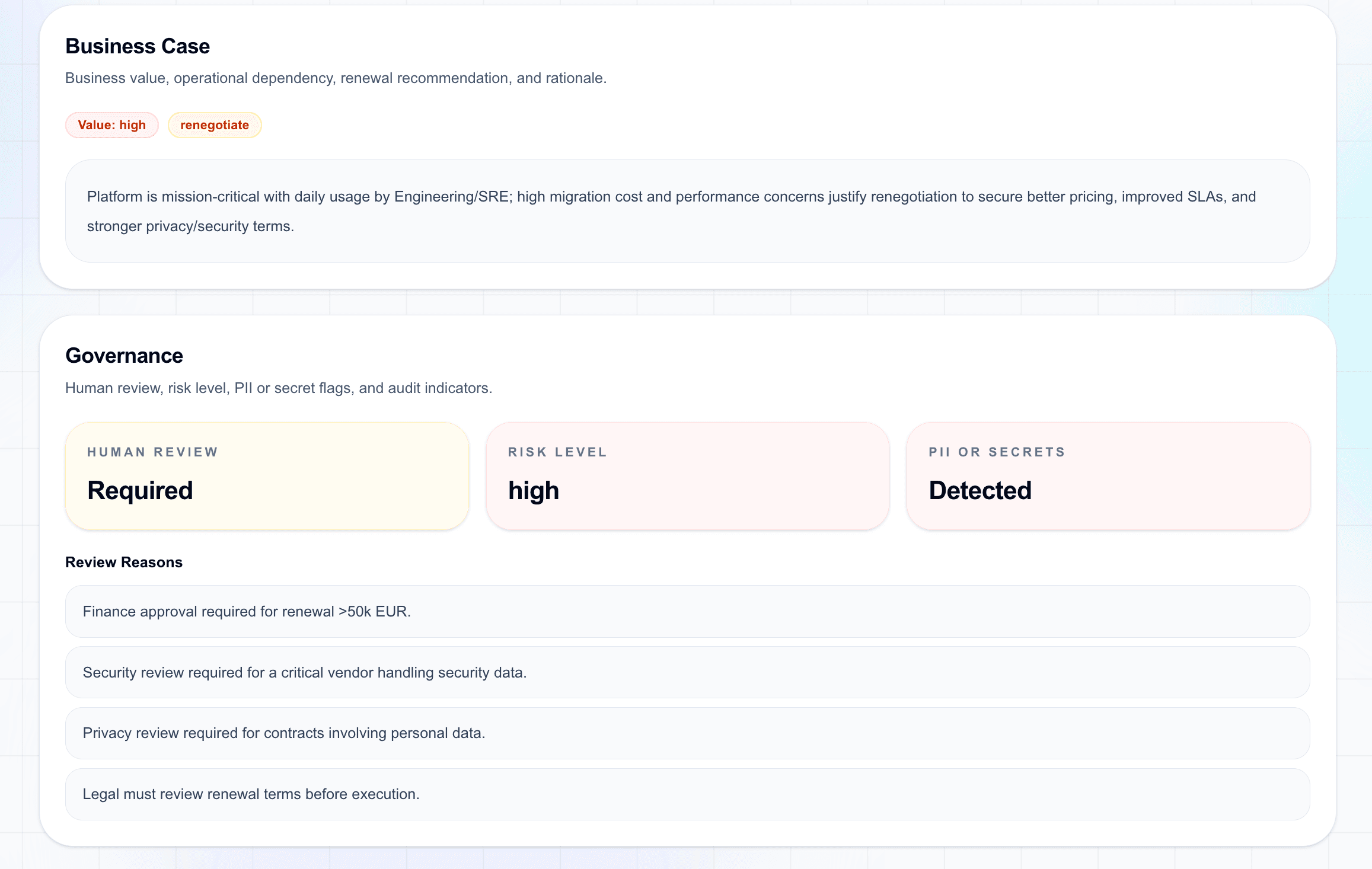
The governance section shows whether human review is required, the overall risk level, whether PII or secrets were detected, and the reasons for review. This turns the renewal workflow into a traceable decision process rather than a one-off AI answer.
Implementation Pattern
The project is implemented as a Next.js App Router application with a client-side dashboard and a backend API route. The frontend manages form state, sample loading, payload preview, analysis results, human review decisions, and structured UI rendering. The backend can use the OpenAI Agents SDK, Zod schemas, input guardrails, output guardrails, specialist agents, and approval-protected tools.
The system can run locally with in-memory approval state for demos. For production deployment, approval state should be stored in a durable database or Redis-like store, and sensitive renewal actions should be connected only after authentication, authorization, role checks, and audit logging are implemented.
Where This Fits in Enterprise AI
This project sits at the intersection of AI agents, contract lifecycle management, procurement operations, enterprise governance, vendor risk, legal review, privacy review, security review, commercial negotiation, and human approval workflows.
The strongest use case is not automatic contract renewal. The strongest use case is renewal intelligence: faster review, clearer approval gaps, consistent vendor performance assessment, better pricing visibility, stronger negotiation preparation, and safer human decision making.
Potential Extensions
- Connect to contract lifecycle management systems such as Ironclad, Icertis, DocuSign CLM, Conga, or Agiloft.
- Connect to procurement and ERP systems such as SAP Ariba, Coupa, Oracle Procurement, Workday, or ServiceNow.
- Add role-based access control for contract owners, procurement, finance, legal, security, privacy, and executives.
- Store approval decisions, reviewer comments, timestamps, risk scores, and state transitions in a database.
- Add vendor master data, contract history, historical pricing, previous amendments, and prior renewal decisions.
- Use retrieval over procurement policy, renewal policy, security policy, privacy policy, legal playbooks, and contract templates.
- Add budget availability checks and cost center validation.
- Add approval chains based on contract value, region, vendor criticality, data sensitivity, and price increase.
- Add email, Slack, Teams, or workflow notifications for approvers.
- Add renewal execution only after finance, legal, privacy, security, and business owner approvals are completed.
Strategic Value
Contract renewals are often rushed because renewal dates, notice periods, pricing changes, stakeholder input, and legal terms are scattered across teams and systems. An AI contract renewal agent can reduce review friction by turning an incomplete or messy renewal request into a structured decision package.
The business value is not only faster renewal review. The deeper value is better governance: every renewal becomes easier to review, explain, negotiate, route, and audit.
Conclusion
The Enterprise Contract Renewal Agent demonstrates how AI agents can be applied to a high-accountability enterprise workflow. It combines specialist analysis, human review, structured output, risk scoring, approval guidance, renewal negotiation support, and governance checks in a practical implementation.
This AI Lab project is intentionally implementation-focused. It shows how a real contract renewal workflow can be transformed from a manual review process into a structured AI-assisted renewal system while keeping humans in control.
FAQ
What is an enterprise contract renewal agent?
It is an AI-assisted workflow that analyzes contract renewal requests, reviews policy requirements, checks vendor performance, evaluates commercial impact, assesses legal risk, and prepares the renewal for human approval.
Does the AI automatically renew contracts?
No. The system is designed for human-in-the-loop contract governance. The AI can recommend, summarize, and prepare the renewal package, but a human reviewer remains responsible for the decision.
Why is human approval important in contract renewal AI?
Contract renewals can involve budget, pricing commitments, vendor lock-in, legal obligations, security risk, privacy exposure, and operational dependency. Human approval ensures accountability and prevents sensitive renewal actions from being executed without review.
What does the system analyze?
It analyzes renewal policy compliance, required approvals, missing information, vendor performance, SLA history, incidents, proposed annual cost, price increase, commercial risk, legal risk, business value, governance flags, and review reasons.
What technologies are used in this project?
The project uses Next.js, React, Tailwind CSS, JavaScript, the OpenAI Agents SDK, Zod schemas, structured JSON output, and human-in-the-loop approval logic.
Can this connect to real contract management systems?
Yes. The workflow can be extended to integrate with contract lifecycle management systems, procurement platforms, ERP systems, ServiceNow, Jira, Slack, Microsoft Teams, Gmail, Outlook, and internal approval workflows.
What is the main business value?
The main value is faster renewal review, clearer approval requirements, better vendor performance visibility, improved pricing negotiation, stronger legal and privacy governance, and safer human-controlled renewal decisions.
About the Builder
Suhas Bhairav builds production-grade AI applications, multi-agent systems, RAG systems, knowledge graph workflows, and enterprise AI prototypes. Learn more at https://suhasbhairav.com.