This AI Lab project demonstrates an Enterprise Organizational Systems Knowledge Brain: a prototype for turning scattered organizational knowledge into a source-aware graph that can be queried by humans and AI agents.
Most companies do not suffer from a lack of information. They suffer from fragmented information. Project notes sit in documents, operational decisions live in chat threads, ownership details are buried in spreadsheets, and critical process knowledge often depends on a few experienced people. This project shows how those fragments can be modeled as a connected organizational system.
The goal is not to build a generic chatbot. The goal is to create a governed knowledge substrate where AI can reason over documents, people, tools, and processes while keeping source references, ownership, and risk visible.
What the Project Demonstrates
The prototype demonstrates a practical enterprise AI pattern: normalize fragmented operating knowledge into structured entities, visualize the resulting relationships, and use an AI brain interface to answer questions with grounded context.
The graph layer helps leaders see how a process actually works across teams. A support workflow may depend on policy documents, an account owner, a product escalation path, a CRM field, and a Slack decision thread. When those pieces are connected, AI answers become easier to verify and operational risk becomes easier to inspect.
Core Capabilities
- Maps documents, people, tools, and processes into a connected knowledge graph.
- Displays organizational dependencies through an interactive force-directed map.
- Supports grounded AI questions over the system map and underlying records.
- Surfaces hidden bottlenecks, missing ownership, outdated references, and process drift.
- Separates source context from generated answers so reviewers can inspect why an answer was produced.
- Creates a reusable knowledge layer that can support future AI agents, workflow automation, and decision support tools.
Why This Matters for Enterprise AI
Enterprise AI systems fail when they are asked to reason over messy reality without a reliable representation of that reality. A knowledge brain gives AI a map: which documents are authoritative, who owns a process, which systems contain the source fields, and which workflows require human review.
This is especially important for organizations exploring AI agents, RAG systems, internal copilots, or workflow automation. Before an AI agent can safely act, it needs to understand context, authority, dependencies, and constraints. A graph-based organizational brain is one way to make those relationships visible.
System Knowledge Map
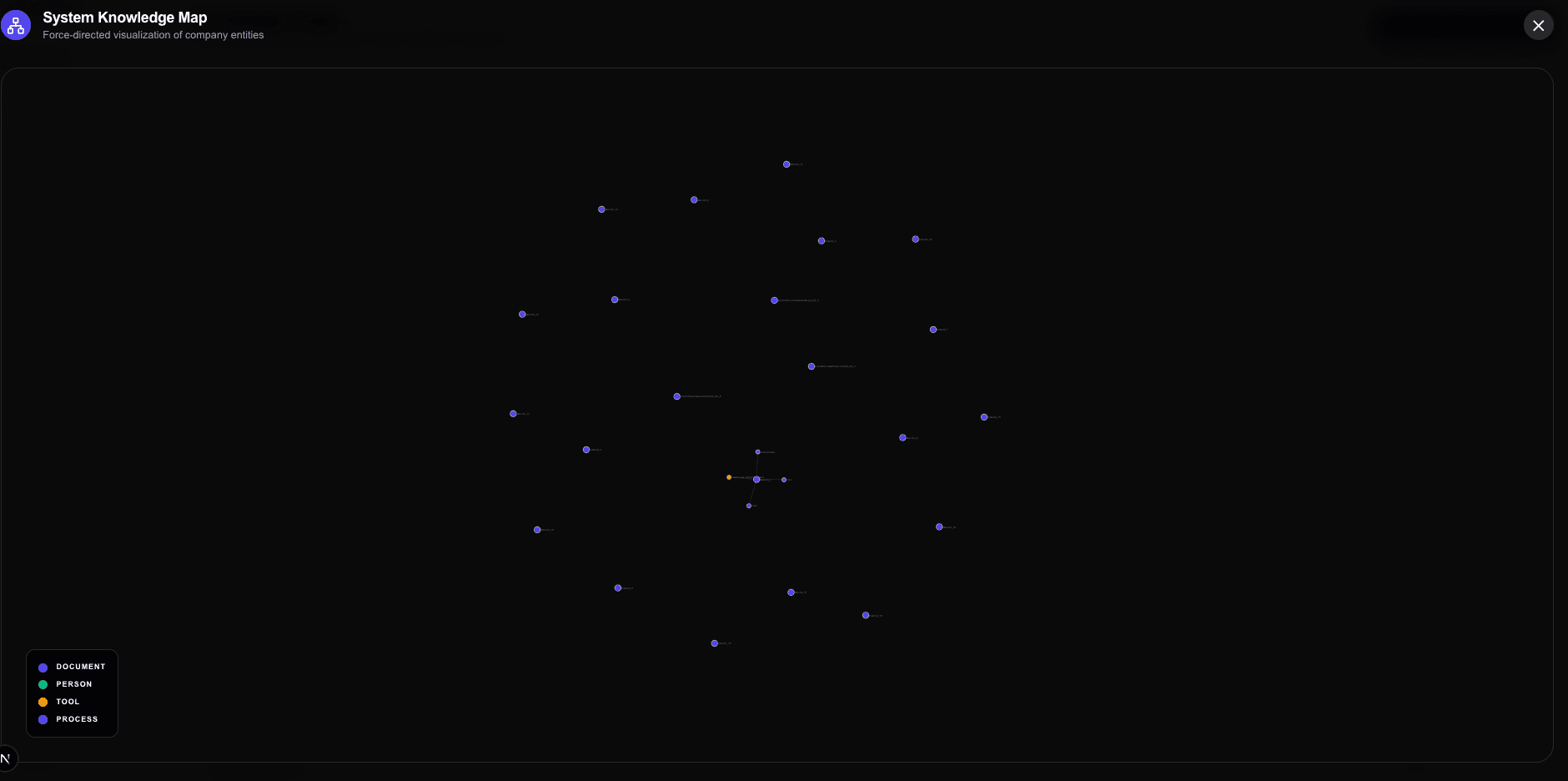
The first interface is the system knowledge map. It turns operating records into a visual topology where each node represents an organizational object such as a document, person, tool, or process. Edges show relationships such as ownership, dependency, reference, escalation, and source-of-truth status.
This makes hidden risk easier to discuss. A process with many dependencies but one human owner may represent knowledge monopoly risk. A tool connected to several workflows but no authoritative documentation may represent operational fragility. A document referenced by many teams but rarely updated may represent stale policy risk.
AI Brain Chat Interface
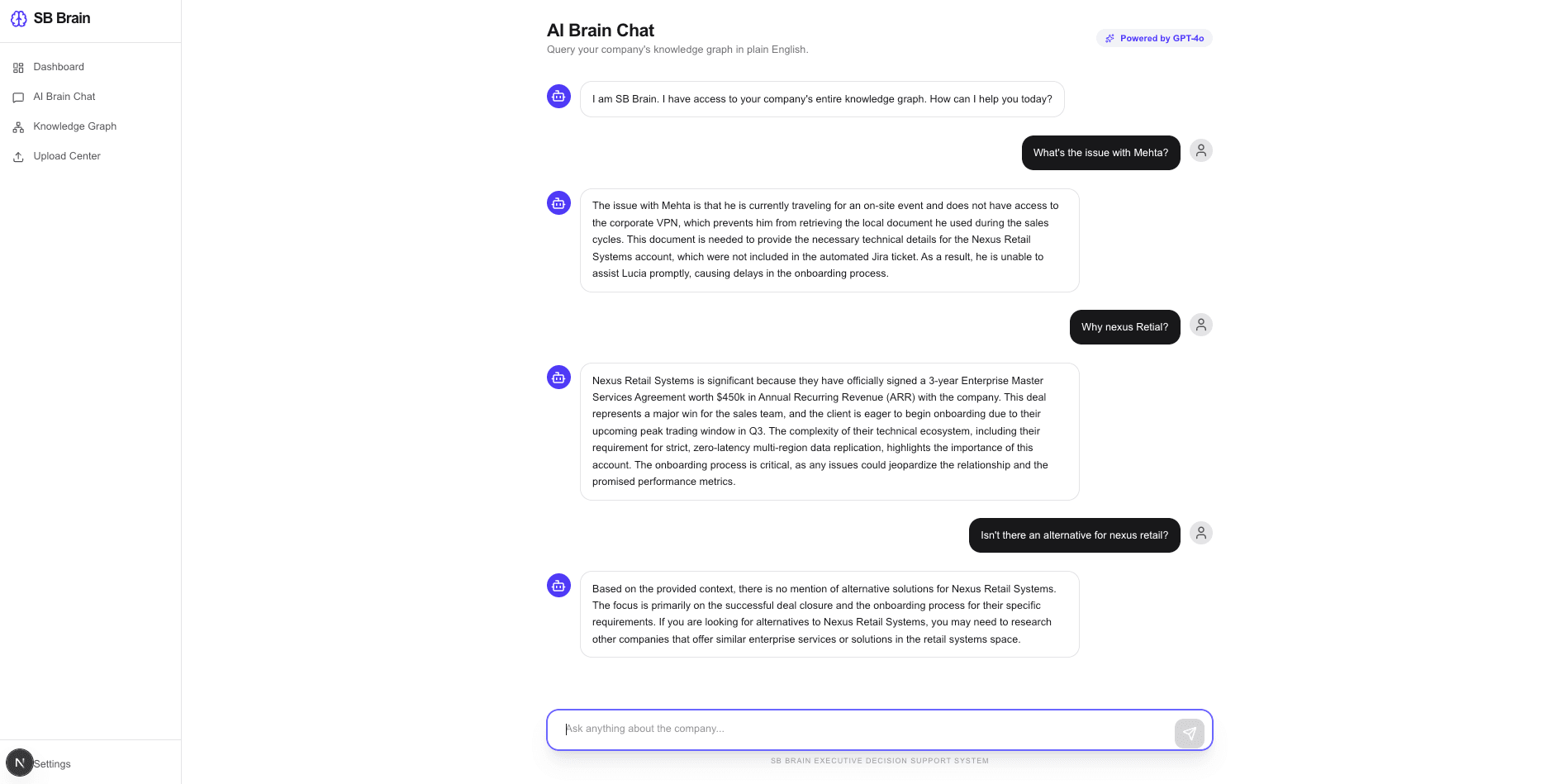
The second interface is a conversational AI brain. The user can ask questions such as which workflow is most dependent on one person, which onboarding steps have missing technical specifications, or which tools appear in multiple escalation paths.
The important design choice is that the answer is not treated as a final truth. The answer should point back to the graph context, source records, and assumptions used to produce it. This is what turns a chatbot into an auditable decision-support interface.
Reference and Source-Aware Reasoning
The project is built around reference awareness. Every useful answer should be traceable to source materials such as process notes, policy files, CRM records, tickets, onboarding documents, or meeting summaries. That traceability matters because enterprise AI needs more than fluent prose. It needs evidence.
In production, this pattern can support source citations, stale-document warnings, missing-owner warnings, and confidence labels. These controls reduce hallucination risk and make AI outputs easier for managers, operators, and auditors to review.
Implementation Pattern
A production implementation would typically include an ingestion layer, entity extraction, entity resolution, relationship mapping, graph storage, retrieval, answer generation, and source auditing. The prototype keeps the concept visible through a web interface, but the architectural pattern can extend to tools such as document repositories, CRMs, ticketing systems, internal wikis, and collaboration platforms.
The most important implementation detail is not the graph visualization itself. The important detail is the data contract: every entity needs an owner, source, type, timestamp, and relationship meaning. Without that structure, the graph becomes another dashboard. With that structure, it becomes a reusable AI context layer.
Related AI Lab and Use Case References
This project connects naturally to enterprise customer support knowledge intelligence, sales knowledge workflow buttons, and policy document question answering. The shared theme is simple: AI performs better when source context, workflow boundaries, and review paths are explicit.
Potential Extensions
- Add source freshness scoring for stale documents and outdated process references.
- Add role-based access control so users only query knowledge they are allowed to see.
- Add confidence and source coverage indicators for every AI answer.
- Connect graph nodes to workflow automation tools with human approval gates.
- Use the graph to identify process bottlenecks, single-owner risk, and missing documentation.
- Export graph slices as decision briefs for leadership, compliance, or operations reviews.
Strategic Value
The strategic value of an organizational knowledge brain is not just faster search. The deeper value is organizational clarity. Teams can see what the company knows, where that knowledge lives, who owns it, how it connects to workflows, and where the system is fragile.
For executives, this creates a practical foundation for AI adoption. Instead of deploying disconnected assistants, the organization can build AI tools on top of a shared, governed knowledge layer.
Conclusion
The Enterprise Organizational Systems Knowledge Brain demonstrates how knowledge graphs, source-aware retrieval, and AI interfaces can work together for enterprise decision support. It turns scattered organizational information into a map that humans can inspect and AI agents can reason over.
This AI Lab project is intentionally implementation-focused. It shows the architectural direction for companies that want AI systems grounded in real organizational context rather than isolated prompt sessions.
FAQ
What is an enterprise organizational knowledge brain?
It is a structured knowledge layer that connects documents, people, tools, and processes so teams and AI systems can reason over organizational context with source awareness.
How is this different from a normal chatbot?
A normal chatbot often answers from text context alone. A knowledge brain models entities, relationships, ownership, source authority, and process dependencies so answers can be inspected and governed.
Does this replace human decision makers?
No. It supports decision makers by organizing context, surfacing dependencies, and preparing source-aware answers. Human owners remain responsible for operational decisions.
Can this connect to real enterprise systems?
Yes. The pattern can be extended to document repositories, CRM systems, ticketing tools, wikis, spreadsheets, chat platforms, and internal workflow systems with proper access control and audit logging.
Why are references important in this project?
References make AI answers reviewable. They help users see which records, documents, and relationships supported the answer instead of relying on unsupported generated text.
About the Builder
Suhas Bhairav builds production-grade AI applications, multi-agent systems, RAG systems, knowledge graph workflows, and enterprise AI prototypes.