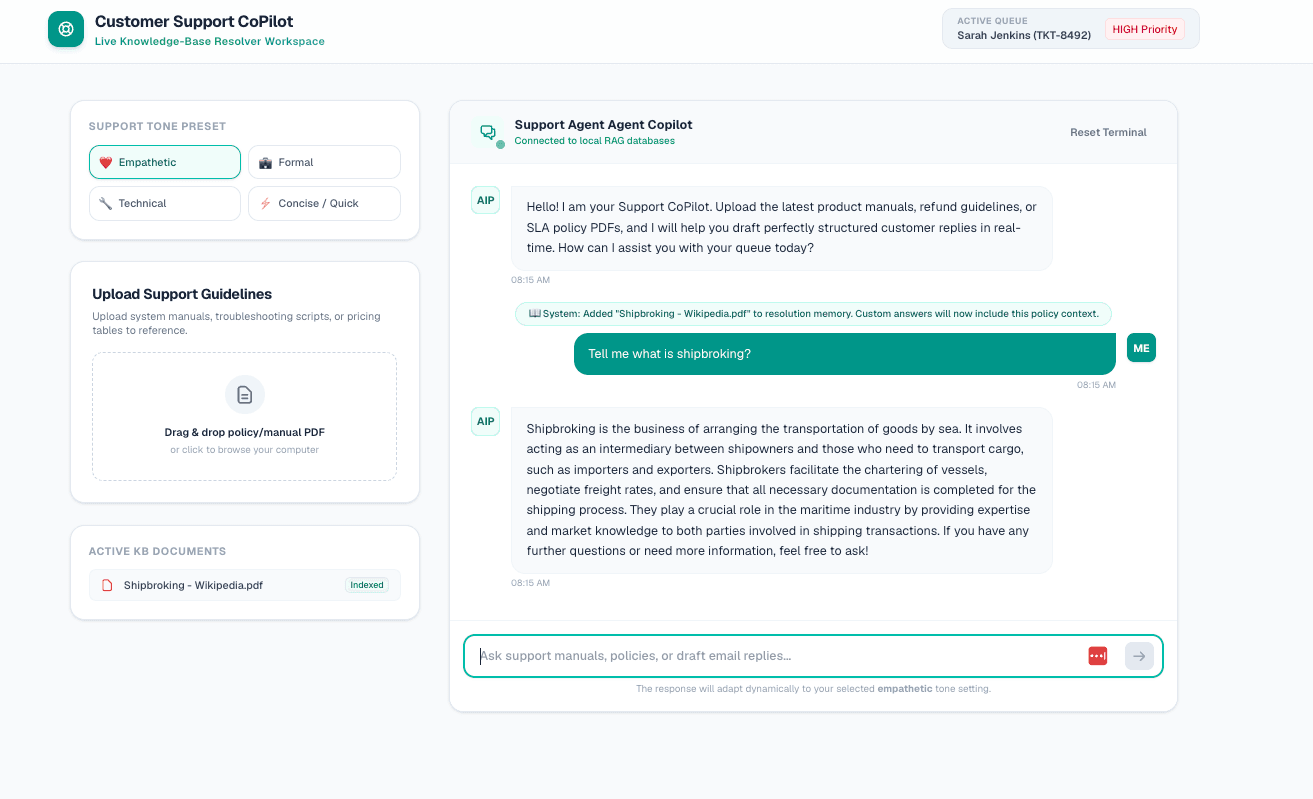
This AI Lab project demonstrates an Enterprise Customer Support AI Copilot built for customer success and helpdesk teams. Combining a robust, asynchronous FastAPI backend with LlamaIndex's localized indexing and OpenAI's state-of-the-art language models, this system transforms massive, unorganized policy sheets—such as SLA manuals, product warranties, technical troubleshooting steps, and company return protocols—into an interactive, compliance-grounded assistant in seconds.
For modern customer operations, resolution speed paired with accurate policy compliance is the ultimate operational metric. The standard bottleneck is support agents hunting through dense internal wiki pages and legal agreements while keeping an upset client waiting. This project showcases how to eliminate that friction point securely, keeping private customer data and corporate policy archives strictly contained within a local storage architecture.
This implementation was developed by Suhas Bhairav as part of a series focused on building production-ready, highly secure enterprise AI solutions with lightweight footprints.
The Architecture: Why Local Vector Stores Matter to support Operations
When deploying generative AI tools into active customer-facing workflows, corporate data protection rules remain paramount. Uploading sensitive partner SLAs or pre-released product technical diagnostics to multi-tenant cloud-hosted vector networks risks data exposure and introduces high maintenance costs.
This prototype demonstrates a localized vector persist-to-disk pattern. Utilizing LlamaIndex, incoming corporate manuals are parsed, chunked, and embedded on the fly, with their index tables written directly to a secure local folder within the application container itself. This architecture offers major benefits:
- Zero External DB Dependencies: Lowers architecture overhead and database subscription fees during customer service pilot rollouts.
- Airtight Compliance: Internal enterprise policies and customer data models stay fully under network control, avoiding leak concerns.
- Sub-Second Retrieval Latency: Local memory lookups perform significantly faster than cloud database endpoints, helping agents lower their Average Handling Time (AHT).
Core Technical Capabilities
- FastAPI High-Concurrency Pipeline: Asynchronous file processing prevents system stalls when service operations managers upload large policy documents.
- Live Ticketing Context Injection: Accepts structural ticket metadata (customer names, account tiers, stated issue summaries) to craft highly personalized drafts.
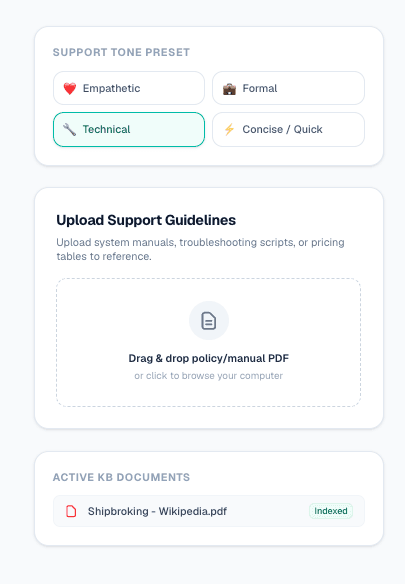
- Dynamic Persona Tone Shifting: Supports hot-swappable system variables that shift the response layout across distinct modes—Empathetic, Technical, Formal, or Concise.
- Stateful Context Engine with Memory: Employs LlamaIndex's
as_chat_engineincontextmode to ground conversations firmly in uploaded business rules while remembering conversational history. - One-Click Clipboard Tools: Includes instant staging elements within the frontend framework allowing agents to verify, copy, and paste drafts into live omni-channel support queues immediately.
How It Accelerates the Support Lifecycle
Consider a standard Tier 2 customer service escalation. A Platinum enterprise partner encounters a product delay and opens a priority dispute requesting shipping expense refunds and immediate product path upgrades. Normally, agents would spend critical time cross-checking contractual agreements and company policies across silos before drafting a compliant response.
With this copilot, the user opens the client workspace where company policies are already mapped to the RAG database. Selecting the 'Delayed Shipping' canned macro instantly interpolates live customer facts and executes a localized vector check. Within seconds, the system yields an actionable resolution draft that strictly respects the firm's true refund parameters, turning multi-hour escalation delays into simple, one-minute validations.
Business-First Workspace Architecture
The companion UI features a clinical teal and slate aesthetic engineered to reduce screen strain over extended agent shifts. It prioritizes access to critical support items: an editable ticket variable card, quick macro prompt injectors, and clear confirmation metrics. For related customer operations patterns, see brand-safe customer-facing AI agents and Zendesk conversation sentiment scoring.
Enterprise-Grade Extension Patterns
While structured as an isolated standalone prototype, this pattern is built to scale directly into enterprise production networks:
- Helpdesk Platform Integration: Hook the API endpoints directly into customer systems like Zendesk, Freshdesk, Salesforce Service Cloud, or Jira Service Management.
- Hybrid RAG Scale: Seamlessly upgrade the storage directory to remote clustered databases (such as Qdrant, Milvus, or pgvector) when mapping corporate knowledge across thousands of product lines.
- Role-Based Access Controls (RBAC): Authenticate endpoint requests via OAuth2 or Active Directory, ensuring support agents only pull policies matching their clearance level.
Strategic Value for Executive Teams
For operations executives and technology leaders, this project shows that deploying highly dependable, domain-specific support engines does not require sacrificing data control or over-allocating integration funds. Blending lightweight frameworks with a smart localized structure enables organizations to deploy custom knowledge tools that lower handling times and improve customer satisfaction from day one.
Conclusion
The Customer Support AI Copilot establishes how focused python microservices can unite with task-oriented frontends to target tangible, operational support metrics. It serves as an architectural blueprint for groups striving to deploy safe RAG environments that maintain human-in-the-loop oversight while accelerating daily service outputs. To evaluate more support automation architectures, check out refund approval guardrails and autonomous technical documentation search.
About the Builder
Suhas Bhairav constructs production-grade AI tools, autonomous multi-agent environments, localized RAG engines, and corporate automation blueprints. For deep technical context on support knowledge systems, explore connecting RAG to private data and support chat transcript analysis.