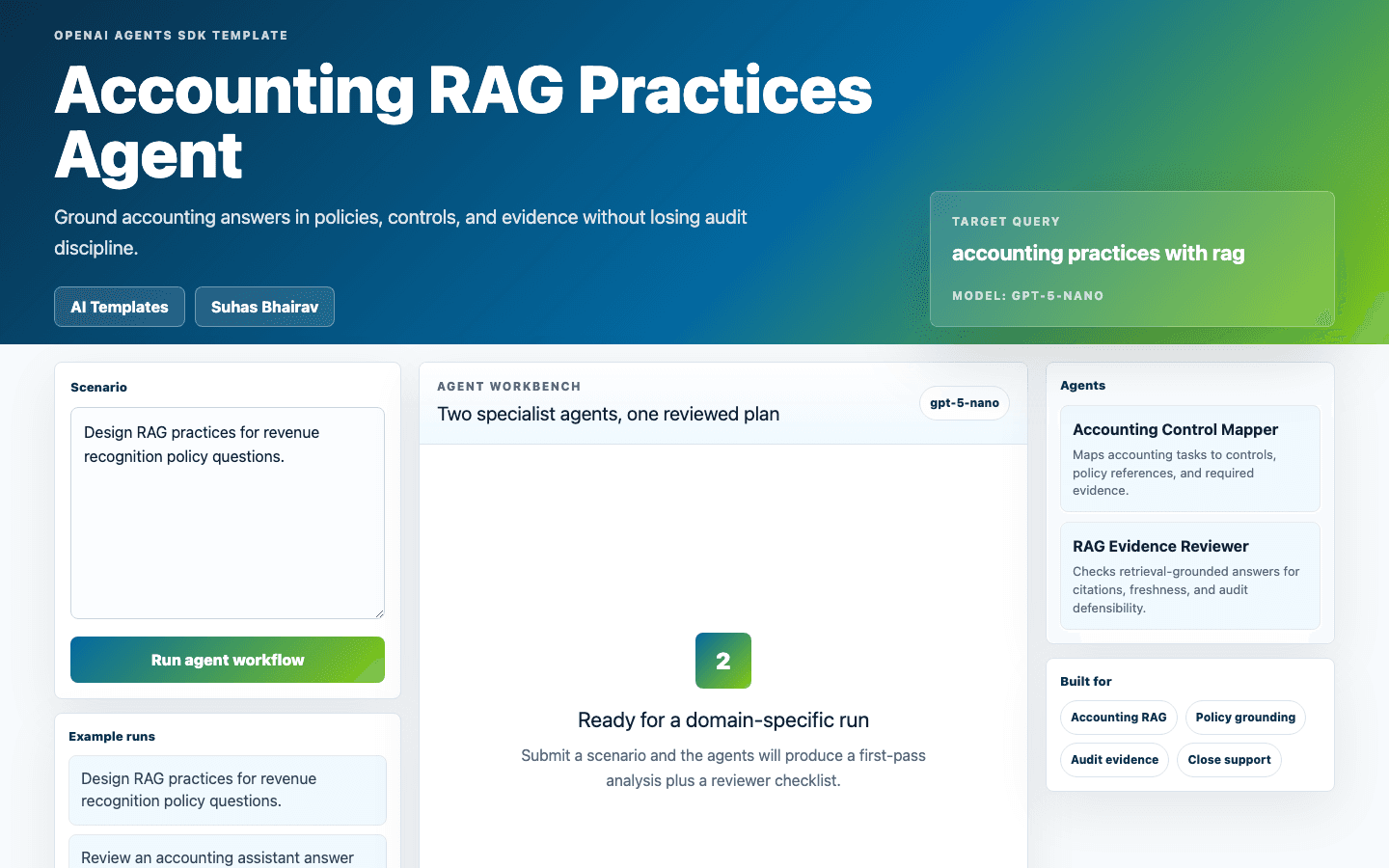
Accounting RAG Practices Agent
Accounting RAG Practices Agent is an open-source Next.js JavaScript AI template by Suhas Bhairav. It uses the OpenAI Agents SDK with Accounting Control Mapper and RAG Evidence Reviewer to support accounting practices with rag.
Direct answer
Accounting RAG Practices Agent is a Next.js RAG chatbot template for document Q&A, OpenAI embeddings, retrieval augmented generation, and AI chatbot answers with citations. It is best for knowledge-base assistants, support documentation bots, document intelligence apps, and internal research copilots.
Features
Use cases
Freshness and tested metadata
- last Tested
- Jul 17, 2026
- last Updated
- Jul 17, 2026
- next Version
- Next.js 16.2.1
- node Version
- Node.js 20+
- runtime
- Next.js App Router
- deployment
- Vercel-ready starter
- license
- MIT
- status
- Open Source
Architecture
Setup path
- 1Clone the GitHub repository linked above.
- 2Install dependencies with npm install.
- 3Create a local environment file from the example variables.
- 4Add the required AI provider API key on the server side.
- 5Run the local Next.js development server and test the primary workflow.
Related AI template categories
Internal template pathways
Frequently asked questions
What is Accounting RAG Practices Agent?
Accounting RAG Practices Agent is a Next.js RAG chatbot template for document Q&A, OpenAI embeddings, retrieval augmented generation, and AI chatbot answers with citations. It is best for knowledge-base assistants, support documentation bots, document intelligence apps, and internal research copilots.
Who should use Accounting RAG Practices Agent?
Use Accounting RAG Practices Agent if you are a Next.js developer, AI product builder, applied AI engineer, or founder looking for an open-source AI app starter instead of rebuilding the same AI interface and server route from scratch.
Is Accounting RAG Practices Agent production-ready?
This starter is production-grade in its AI safety baseline: prompts are hardened against prompt-injection attempts, provider calls stay server-side, unsafe inputs are constrained, and client-facing errors are kept safe. You should still expand it for your use case by adding or adapting authentication, tenant isolation, persistent storage, observability, quotas, billing, and business-specific policy checks before a real launch.